Count the contacts in a brisk hour of walking and the number climbs into the thousands, each one delivering a ground reaction force greater than your bodyweight. That is the load your feet negotiate every time you lace up to get the steps in. When the heels start throbbing, the forefoot begins to burn, or the last stretch home feels like a slog, the issue is rarely your fitness. It is what sits between your sole and the pavement.
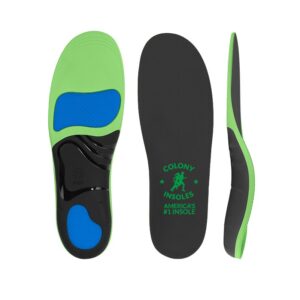 Doctor-Designed Orthotic
Premium Colony Ortho RX
- Recommended by podiatrists
- Memory foam + gel with real arch support
- 60-day money-back guarantee
- Free shipping within the USA
The accumulation problem
Walking is a long series of single-limb landings, and each landing routes force up through the calcaneus and along the arch. The die-cut liner shipped inside most shoes attenuates almost none of it. Over distance, the posterior tibialis and the small intrinsic muscles that defend the arch tire out, the rearfoot drifts into excess pronation, push-off loses its recoil, and fatigue arrives well ahead of your target distance. The repetition is the whole story: small, sub-threshold loads stack until they are no longer small.
Engineering for the full distance
The Colony Ortho RX insole is built to hold the foot for the entire route rather than the opening blocks. A conforming foam layer over a gel base absorbs each footstrike and blunts the repetitive shock of hard ground, while a contoured shell supports the medial longitudinal arch and helps keep the foot tracking efficiently mile after mile. It is podiatrist-engineered to keep the foot mechanically stable, which tends to turn a daily chore into something you genuinely want to head out and do.
Who logs miles on these
Habitual walkers, dog owners, commuters covering ground on foot, and weekend ramblers building toward bigger step counts will all feel the difference where it matters.
- Conforming foam and gel dampening impact across the entire walk
- Contoured arch support that moderates pronation and preserves an efficient stride
- Genuine shock attenuation sparing the heels, knees, and hips
- Drops into sneakers, trainers, and everyday walking footwear
- Free shipping in the USA plus a 60-day money-back guarantee
Support the foot the right way and you walk longer and more consistently, and that consistency is where the cardiovascular payoff actually accrues. No more trimming the route because you already know how the evening will feel. For longer days upright, read our guide to insoles for standing all day, and match the device to your footwear on our walking shoe inserts page.
One orthotic, one straight price, and many well-supported miles ahead. Order Colony Ortho RX and cover the full distance.
Related Insoles & Guides
- Women's Insoles for All-Day Comfort
- High Arch Insoles for All-Day Comfort
- Comfort Insoles for All-Day Relief
- Best Shoe Inserts for All-Day Comfort
- Comfort Shoe Inserts for All-Day Relief
- Men's Insoles for All-Day Support
Frequently Asked Questions
What makes mile five feel so much worse than mile one?
Accumulation. Every landing routes a force greater than body weight through the calcaneus and along the arch, thousands of times per hour. Individually those loads are sub-threshold; stacked over distance they exhaust the posterior tibialis and the small intrinsic muscles defending the arch. Once those tire, the rearfoot drifts into excess pronation and ordinary steps start to register as throbbing.
How is this different from the liner my walking shoes came with?
The die-cut sheet inside most shoes is a sizing filler, not a support structure — it attenuates almost none of each footstrike. Colony Ortho RX replaces it with working anatomy: a contoured shell that holds the medial longitudinal arch, a gel base that absorbs repetitive ground shock, and a conforming foam deck that distributes pressure across the whole plantar surface.
Do I still need structured support if my shoes are already well cushioned?
Cushioning and control solve different problems. Foam softens each landing, but it cannot stop the rearfoot from drifting into excess pronation once the arch muscles fatigue over distance. Softness alone gives the foot nothing to align against. The gel base handles repetitive impact while the contoured shell preserves arch posture, so support is still there in the late miles when muscles are not.
Can better support change how far I can comfortably walk?
It changes the load math. When an insole absorbs part of each footstrike and holds the arch in position, the stabilizing muscles spend less of their capacity fighting alignment and shock, so the fatigue threshold arrives later in the route. Push-off keeps its recoil longer, too, because a supported arch returns energy more efficiently than a collapsing one.