What heel pain quietly takes from you
That guarded, wincing first step before the sole even touches the bedroom floor is a signal most people learn to dread. For others the heel announces itself differently, a deep bruised throb that thickens over a long stretch on a hard surface. Either way the calcaneus carries the single highest load in the gait cycle, and when nothing beneath it manages that load, it protests loudly enough to reshape your day. Colony Ortho RX was engineered to intervene at exactly that point of contact.
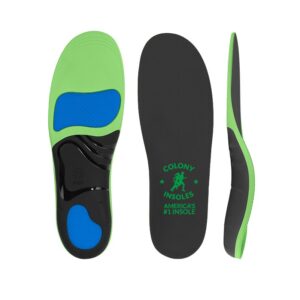 Doctor-Designed Orthotic
Premium Colony Ortho RX
- Recommended by podiatrists
- Memory foam + gel with real arch support
- 60-day money-back guarantee
- Free shipping within the USA
Why cushioning alone leaves the heel exposed
Look at the mechanics. The heel bone makes first contact at strike and absorbs the largest force of any phase of the stride. With no shock media or alignment underneath, that force drives straight into bone, into the insertion of the Achilles, and into the plantar fascia anchored along the sole. Repeat that loading across a working week and irritation digs in. Genuine rearfoot support has to do two things simultaneously: soften the calcaneus at the moment of strike, and preserve rearfoot and arch alignment so the force spreads across the foot rather than piling onto one overworked region.
How this orthotic shields the calcaneus
The device was built with the rearfoot as the priority. A gel base seats directly beneath the heel to dissipate the impact of each landing, with memory foam above it conforming to the surface of your foot. The structured, geometric arch keeps the foot in functional position, so the calcaneus is never left to swallow the full force on its own. It is podiatrist-engineered and built to help you stand, walk, and run with less discomfort.
- Gel placed to dissipate force at every heel strike
- Memory foam molding to the heel and arch as one unit
- Structured support that spreads load across the entire foot
- May reduce that braced first-step soreness in the morning
- One medical-grade pair, $29, with no add-ons
Whether this is for you
If you wake to a sharp heel, spend hours on concrete or tile, or feel an ache settle in after exertion, heel inserts belong in your footwear. Heel pain that persists deserves a podiatrist’s assessment. If you suspect padding isn’t the whole answer and want broader structural support, our arch support page explains the layered geometry, and you can weigh the options against our best shoe inserts guide.
This information is educational and does not diagnose or treat any condition. Each pair ships FREE across the USA with a 60-day money-back guarantee, so you can test them on your worst days with nothing on the line. Order your Colony Ortho RX and give the rearfoot the protection it has been missing.
Related Insoles & Guides
- Heel Cups for Heel Pain Relief
- Heel Support Insoles for Heel Pain Relief
- Shoe Inserts for Back of Heel Pain
- Shoe Inserts for Hip Pain Relief
- Insoles for Plantar Fasciitis & Heel Pain
- Shoe Inserts for Foot Pain Relief
Frequently Asked Questions
Why is the first step out of bed often the worst one?
After hours off your feet, the soft tissue anchored to the heel — particularly the plantar fascia along the sole — rests in a shortened, unloaded state. The first steps reload the calcaneus abruptly, and irritated tissue protests until it adapts. It’s a common pattern with heel irritation, and persistent or worsening first-step pain is worth discussing with a clinician.
How is the calcaneus protected at the moment of heel strike?
The rearfoot was the design priority. A gel base seats directly beneath the heel bone to attenuate the impact of first contact — the largest single force in the gait cycle — while the structure above maintains rearfoot and arch alignment. Softening the strike and holding alignment together lets force spread across the foot instead of piling onto one overworked region.
Can heel pain really be a whole-foot alignment problem rather than just a heel problem?
Often, yes. The calcaneus takes the highest load in the stride, but how much it absorbs depends on what the rest of the foot is doing. When rearfoot alignment drifts and the arch stops sharing work, force concentrates at the heel, the Achilles insertion, and the fascia anchored along the sole. That’s why effective relief pairs cushioning with alignment, not cushioning alone.
When is heel pain something to take to a podiatrist instead of managing with an insert?
An orthotic manages load; it doesn’t diagnose. If heel pain is severe, follows an injury, comes with swelling or numbness, or hasn’t eased after a reasonable period of offloading and supportive footwear, have it evaluated. Inserts like ours are a conservative, everyday load-management measure — a complement to professional care, not a substitute for it.