The magnet claim, and what biomechanics actually says
At Colony Ortho RX we field the same question almost every week: do magnetic shoe inserts do anything for aching feet? It’s a fair thing to wonder when you’re hours into a shift and the arch is throbbing. The honest answer is that foot pain is usually a load and alignment problem, not something a small magnet under the lining can influence. When the heel and arch aren’t held in position, soft tissue takes strain it wasn’t built to carry. That mechanical reality is where relief has to start.
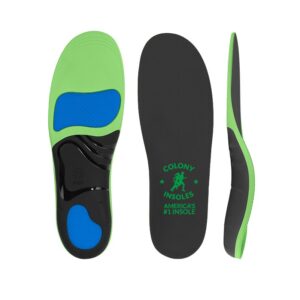 Doctor-Designed Orthotic
Premium Colony Ortho RX
- Recommended by podiatrists
- Memory foam + gel with real arch support
- 60-day money-back guarantee
- Free shipping within the USA
Relief comes from structure under load
Three mechanical functions change how a foot tolerates a long day. Rearfoot and arch support resists the inward collapse of pronation, so the plantar fascia and posterior tibial tendon aren’t stretched past their working range with every step. Cushioning places a compliant layer between soft tissue and an unforgiving floor. Shock attenuation dampens the impact spike at heel strike before it travels up the kinetic chain into the knee, hip, and lower back. You register all three the moment you stand. None of them depend on magnetism.
How the Colony Ortho RX orthotic is engineered
We designed our orthotic insole around the loaded foot rather than a novelty feature. A structured, geometric arch frame supports the medial longitudinal arch and helps control excess pronation through stance. Dual-layer memory foam conforms to your individual foot contour and distributes pressure away from hot spots. A targeted gel layer absorbs landing forces at the rearfoot. It’s a podiatrist-designed, medical-grade build meant to support standing, walking, and running, offered as one honest pair at $29.
- Structured arch support that engages the medial arch under load
- Pronation control to ease tension on the plantar fascia
- Memory foam that conforms to your foot and spreads pressure
- Gel shock attenuation that buffers the heel-strike impact spike
- A podiatrist-designed orthotic built on real foot mechanics
To understand what carries the load, read our arch support design, or look at why patients choose our podiatrist-recommended inserts over magnet-based products.
Who this orthotic suits
If you’ve been tempted by a quick-fix insert but suspect the science isn’t there, this is the better-grounded choice. Mechanical support is measurable; you feel it the instant you weight the foot. Every pair ships FREE within the USA with a 60-day money-back guarantee. This is general foot-health education, not personal medical advice, so persistent or worsening pain is worth a podiatrist’s evaluation. Order your Colony Ortho RX orthotics today and judge the support standing up.
Related Insoles & Guides
- Z-Liner Insoles: Slim Fit + Real Support
- Gel Insoles for Real Shock Absorption
- Arch Support Shoe Inserts
- Arch Support Shoe Inserts
- Shoe Inserts Crossword Clue & the Real Thing
- High Arch Support Inserts
Frequently Asked Questions
Do magnetic insoles actually do anything for tired, aching feet?
Not by any mechanism biomechanics can point to. End-of-shift foot pain is usually a load and alignment problem — an arch collapsing further than its soft tissue tolerates — and a small magnet under the lining cannot change how the heel and arch are held or loaded. Relief has to start with the mechanics.
What makes an insole genuinely therapeutic if it isn't magnets?
Three mechanical functions you register the moment you stand. Rearfoot and arch support resists the inward collapse of pronation, sparing the plantar fascia and posterior tibial tendon their overstretch. Cushioning places a compliant layer between soft tissue and unforgiving floors. Shock attenuation dampens the heel-strike spike before it climbs toward knee, hip, and back.
Is there any harm in simply trying a magnetic insert first?
The magnet itself is benign. The cost is what you’re standing on meanwhile: these inserts are typically thin, flat liners, so the arch keeps collapsing and the strain pattern behind the ache continues unaddressed. Pain that persists or worsens is a signal to see a clinician, not to try a stronger magnet.
How does the Colony Ortho RX orthotic resist that inward arch collapse?
With geometry under load rather than an add-on feature. A structured arch frame supports the medial arch through stance, so pronation stops short of overstretching the plantar fascia, while memory foam distributes plantar pressure and a gel layer attenuates heel-strike impact. Every element maps to one of those named mechanical functions.