The biomechanics of a shoe that fits loosely
A footwear shell that exceeds the volume of the foot it surrounds creates a measurable instability problem, not merely a nuisance. When internal space goes unoccupied, the foot is free to translate fore-and-aft and medial-to-lateral during the stance phase of gait. Each of those micro-displacements represents energy that should have gone into propulsion but instead dissipates as shear and uncontrolled motion. Whether the shoe was sized up, ran large from the factory, or relaxed in the upper after months of wear, the consequence on the foot is identical: a platform that no longer constrains the structure standing on it.
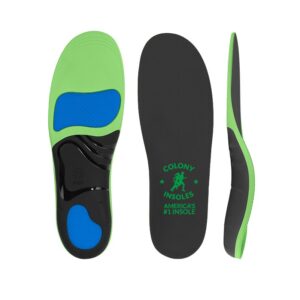 Doctor-Designed Orthotic
Premium Colony Ortho RX
- Recommended by podiatrists
- Memory foam + gel with real arch support
- 60-day money-back guarantee
- Free shipping within the USA
What unoccupied volume does to the foot’s mechanics
An oversized fit undermines two things the foot relies on during loading. First, the rearfoot loses its anchor, so the calcaneus pistons upward at the back of the shoe during push-off rather than staying seated. Second, the medial longitudinal arch is left to span open air through midstance, which removes the timely support that helps decelerate pronation. The intrinsic and extrinsic muscles then work overtime to compensate for a base that keeps shifting, and that extra recruitment is what registers as early fatigue across the foot and lower leg.
How a structured orthotic reclaims the fit
The corrective approach is volumetric and mechanical at once. A doctor-designed orthotic occupies the slack a thin stock liner leaves behind, raising the foot into firm contact with the upper so lateral and forward drift is eliminated. The conforming top surface molds to your individual contour, while the rigid arch shell and deep heel seat physically locate the foot over its intended footprint. Rather than wadding padding into excess room, the insole re-references the entire shoe to your anatomy. A single pair resolves it, at $29.
- Displaces empty interior volume so the foot stops translating during stance
- A heat-conforming top layer that captures your unique contour for a locked-in seat
- A supportive arch shell that decelerates pronation and offloads fatigued muscle
- A deep rearfoot seat that prevents calcaneal pistoning at push-off
- Complimentary US shipping on a clinically engineered orthotic platform
Consider this if
your footwear feels generous through the heel, has loosened with mileage, or simply sat one half-size too large from the start. Controlling internal motion this way also suppresses the repetitive rubbing that lifts blisters, so reviewing how we help prevent blisters complements this fix. When the dominant symptom is the foot creeping toward the toe box on declines, the mechanics covered in our guide on feet sliding forward finish the picture. This is general education, not individualized medical advice.
A shoe you value is worth fitting correctly rather than abandoning. Re-reference it to your foot with real structure and let the rearfoot finally stay put. Trial Colony Ortho RX risk-free for 60 days under our money-back guarantee. Order a pair and dial the fit in for good.
Related Insoles & Guides
- Insoles to Make Loose Shoes Fit Tighter
- Insoles to Make Shoes Smaller
- Inserts to Make Big Shoes Fit
- Insoles to Make Shoes Smaller & Fit
- Best Shoe Inserts for All-Day Comfort
- Heel Inserts for Heel Pain Relief
Frequently Asked Questions
Does adding an insole genuinely make an oversized shoe fit tighter?
It corrects a volume mismatch. The contoured base occupies dead space and lifts the foot slightly so the upper engages the midfoot, while the heel seat anchors the calcaneus against fore-and-aft drift. What it cannot do is shorten a shoe that is truly too long; that is a length problem, not a volume problem.
How is a structured insole different from heel grips or tongue pads?
Pads address a single contact point and leave the platform unchanged, so the foot keeps translating across a flat footbed. A structured orthotic works from below: it seats the rearfoot, supports the medial longitudinal arch through midstance, and fills unoccupied volume under the entire foot. Stability comes from the foundation, not from a patch.
Why do slightly-too-big shoes leave my feet and lower legs so tired?
Unoccupied volume makes your muscles do the shoe’s job. The calcaneus pistons at push-off, the arch spans open air through midstance, and the foot’s intrinsic and extrinsic muscles fire continuously to stabilize the shifting base. That extra recruitment is the early fatigue you feel. Restore a snug, supported platform and that energy returns to propulsion.
Can I leave the factory liner in and stack this insole on top?
In a notably roomy shoe, yes. Layering over the flat factory liner takes up additional volume, provided your heel still seats fully without lifting at the counter and your toes keep clearance. In shoes closer to a normal fit, remove the liner and trim the orthotic to its outline so the structure does not overcrowd the interior.