What a high arch does to load distribution
With a high arch, often described clinically as a cavus foot, body weight concentrates on two regions, the heel and the metatarsal heads, while the midfoot floats over open space and makes almost no contact. I’m Jack Young, founder of Colony Ortho RX, and high-arched feet are among the most common we fit. Concentrate every step’s load onto those two points for eight or nine hours and the result is predictable: aching arches, forefoot fatigue, and symptoms that frequently travel into the knees and lower back by evening.
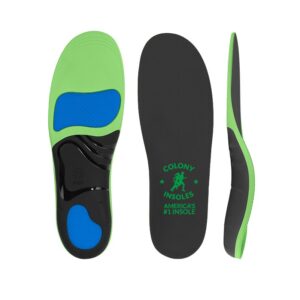 Doctor-Designed Orthotic
Premium Colony Ortho RX
- Recommended by podiatrists
- Memory foam + gel with real arch support
- 60-day money-back guarantee
- Free shipping within the USA
Why high arches need more support, not less
A cavus foot is rigid. It doesn’t pronate and flatten to share load the way a flexible foot does, so it attenuates less shock on its own and transmits impact directly into the heel and forefoot. A flat, generic insole does nothing here, because the gap beneath the midfoot stays empty. What this foot type needs is a tall, deliberate arch contour that rises to meet the foot where it lifts and finally fills that space, so load spreads across the entire footbed instead of two concentrated pressure points.
How we fill the gap and redistribute load
We designed the arch on our orthotic to make genuine contact with a higher foot, not the token bump found in most inserts. Above that structured, geometric arch support sits a memory foam and gel layer that softens the hard heel-and-forefoot strike rigid arches are known for. That’s the pairing clinical support calls for: firm structure underneath, shock attenuation on top. The midfoot begins carrying its share, the high-pressure zones ease, and standing and walking stop counting down to soreness. One medical-grade orthotic, $29 a pair.
- A tall, structured arch that genuinely contacts a high or cavus foot
- Plantar pressure pulled off the heel and the metatarsal heads
- Memory foam and gel to attenuate the impact rigid arches transmit
- Relief for fatigue that tends to travel to the knees and lower back
- Steady support through long days on hard flooring
If you’re also working with a shoe that runs roomy, this same arch contact helps you make big shoes fit, and our cushioned memory foam inserts sit naturally alongside the added midfoot support.
Who this suits
Runners and hikers, anyone told they have high or rigid arches, and the people who feel every step land on the heel and forefoot with nothing in between. If flat insoles have never felt like enough, it isn’t your imagination, a rigid arch needs solid structure to push back against.
Give your arches the contact they’ve been missing. We ship free across the U.S. with a 60-day money-back guarantee. Order your pair today and feel your whole foot sharing the load again.
Related Insoles & Guides
- High Arch Support Insoles for Pain Relief
- Arch Support Shoe Inserts
- Arch Support Shoe Inserts
- Insoles for Pregnancy: Arch & Foot Support
- Insoles for Flat Feet & Arch Support
- High Arch Insoles for All-Day Comfort
Frequently Asked Questions
Why do my heel and the ball of my foot hurt if my arch is high?
In a cavus foot the midfoot barely touches the ground, so nearly all body weight funnels into two small zones, the heel and the metatarsal heads. Those concentrated pressure points absorb every step’s load for hours at a time, which is why high-arched feet often ache at both ends while the arch itself gets almost no contact.
What makes this arch profile different from the bump in ordinary inserts?
Most inserts carry a token rise that never reaches a high-arched foot, leaving the midfoot gap empty. Colony Ortho RX shapes a taller, structured contour that climbs to meet the lifted arch and makes genuine contact, so load spreads across the whole footbed instead of concentrating at the heel and forefoot.
Does a rigid cavus foot handle impact differently than a flexible foot?
Yes. A flexible foot pronates slightly to dissipate impact; a rigid cavus foot skips that motion and passes shock straight into the heel, forefoot, and the joints above. Cushioning layered over a supportive contour attenuates some of that impact, while the arch contact shares load the foot cannot redistribute on its own.
Can supporting a high arch ease aching knees or a tired lower back?
It can contribute. When a cavus foot transmits unattenuated impact upward, the knees and lower back often register it by evening. Filling the midfoot so each step loads the full footbed reduces that transmitted stress. Persistent knee or back pain still deserves a clinician’s evaluation, since many factors beyond foot mechanics can drive it.