A Pelvis That Sits Slightly Crooked
Limb length asymmetry is far more common than most people realize, and the majority carry a small one without ever naming it. What registers instead is a hip that nags on one side, heels that wear at different rates, and a low back that stays guarded no matter the mattress. If any of that rings true, a structured supportive orthotic is a sensible, low-stakes way to begin building a more even platform beneath both feet. It is not a diagnosis, though, and a genuine discrepancy deserves confirmation and measurement by a qualified clinician.
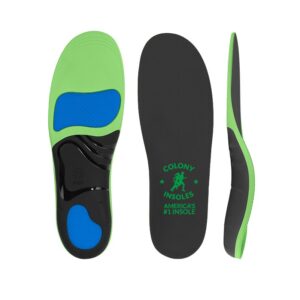 Doctor-Designed Orthotic
Premium Colony Ortho RX
- Recommended by podiatrists
- Memory foam + gel with real arch support
- 60-day money-back guarantee
- Free shipping within the USA
How a Few Millimeters Cascade
When the limbs aren’t level, the sacrum and pelvis tilt toward the shorter side, and the lumbar spine bends to keep the eyes horizontal and the head upright. The body is remarkably good at this accommodation, but every compensation routes the load somewhere: lopsided pressure through one sacroiliac joint, one knee, one hip, and one paraspinal column, reproduced with each of the day’s thousands of steps. Restoring a stable, balanced base helps temper that asymmetric pattern, so movement through routine tasks, the stairs, the checkout line, the morning commute, distributes more evenly across both sides.
How the Orthotic Levels Your Base
Our device delivers cushioned, geometrically structured support to each foot so you launch from a steady, symmetric foundation. The memory foam and gel construction spreads plantar pressure and absorbs impact at every contact, while the contoured arch frame braces the medial column and checks excessive inward roll. Many patients pair ours with the heel-lift protocol their physician prescribes, letting the shock-attenuating base contribute to all-day comfort underneath that correction.
- Balanced, structured support engineered beneath both feet
- Memory foam that distributes load across the full plantar surface
- Impact-absorbing gel for smoother, more symmetric ground contact
- Podiatrist-designed arch support that reinforces alignment
- FREE USA shipping and a slim profile for everyday footwear
Who Reaches for This
If you’ve noticed asymmetric heel wear, one-sided hip or lumbar discomfort, or you simply want a more grounded stance, this orthotic earns its keep. For a wide, secure footing on slippery surfaces, see our non-slip insole, and if you’re comparing higher-priced devices, read why patients choose us over Superfeet.
Plainly stated: a confirmed limb length discrepancy belongs in the hands of your doctor or podiatrist, and our orthotic complements whatever plan they design rather than standing in for it. This is general education, not individual medical advice. Try it risk-free for 60 days at $29 a pair, and if you don’t feel steadier, we refund you. Order your pair and start from a more level foundation.
Related Insoles & Guides
- Shoe Inserts for Uneven Leg Length
- Best Shoe Inserts for All-Day Comfort
- Heel Inserts for Heel Pain Relief
- Gel Insoles for Real Shock Absorption
- Height-Boosting Shoe Inserts
- Orthopedic Shoe Inserts
Frequently Asked Questions
Can an over-the-counter orthotic correct a leg length discrepancy?
No, and we won’t claim it does. A genuine discrepancy deserves measurement by a qualified clinician, who may prescribe a specific lift. What a structured orthotic can do is stabilize the rearfoot and support both arches evenly, so the platform beneath your pelvis stops adding its own asymmetry to whatever difference exists.
What signs suggest my legs might not be quite the same length?
Common clues are heels that wear at different rates, a hip that nags on one side only, and a low back that stays guarded no matter the mattress. None of these confirm a discrepancy — other conditions mimic the same pattern — which is why clinical measurement matters before you settle on a cause.
Should I wear the insole in one shoe or in both?
Both. These are paired orthotics built to create an even, supported base under each foot, not a unilateral lift. Adding height to one side only is a clinical decision that should follow actual measurement. Wearing the pair keeps arch support and heel cushioning symmetric, which is the whole point of leveling your platform.
How do a few millimeters of difference end up bothering my lower back?
When the limbs aren’t level, the sacrum and pelvis tilt toward the shorter side and the lumbar spine curves to keep the head upright. Each step then routes extra load through one sacroiliac joint and one paraspinal column. Repeated across thousands of daily steps, that compensation becomes a persistent one-sided strain pattern.