The Difference Between a Cushion and a Corrective Device
Walk down any drugstore aisle and you’ll find a wall of foam inserts promising relief between the vitamins and the bandages. They’re cheap, they’re everywhere, and for a few days they feel like a win. But here’s the distinction worth understanding: most of those products are passive cushions, not corrective orthotics. A cushion softens contact with the ground. An orthotic changes how your foot is positioned while it bears your weight. Those are two very different jobs, and only one of them addresses why your feet hurt in the first place.
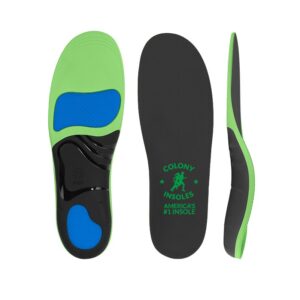 Doctor-Designed Orthotic
Premium Colony Ortho RX
- Recommended by podiatrists
- Memory foam + gel with real arch support
- 60-day money-back guarantee
- Free shipping within the USA
Where Mass-Market Foam Falls Short Biomechanically
The trouble with a stamped pharmacy insert is that it treats every foot as the same foot. It carries no meaningful rearfoot posting and no defined arch contour, so it can’t influence the inward roll that drives so much lower-limb strain. Add the material problem: open-cell foam compresses permanently under repeated loading, losing whatever loft it started with inside a couple of weeks. What you’re left with is a flattened liner that no longer absorbs impact and never controlled motion to begin with. You buy a replacement, the cycle repeats, and the underlying mechanical fault, an arch collapsing through midstance, goes untouched the entire time.
What a Structured Orthotic Does Instead
Colony Ortho RX takes a different approach. A rigid geometric arch shell sits beneath a layered memory foam and gel top, so the device guides your pronation toward a neutral track while still attenuating shock at every heel strike. The shell holds its corrective geometry through months of wear rather than surrendering by the weekend, which means the support stays engaged when your body actually demands it. This is the construction podiatrists design around precisely because it manages load instead of merely masking the symptom of fatigue.
- A semi-rigid shell that resists deformation and keeps controlling arch motion long-term
- Rearfoot guidance that limits overpronation rather than ignoring it
- Combined gel and foam that absorb impact and protect the heel and ankle joints
- One durable orthotic in place of an endless run of disposable refills
- Medical-grade engineering built around real foot mechanics
Who Should Step Off the Replacement Treadmill
If your shopping list quietly includes a fresh set of inserts every month, you’re carrying a cost the receipt never shows. There’s a better answer than another impulse buy. People dealing with heat and moisture can read how structure helps on our sweaty feet guide, while those wanting deeper midfoot contact often start with high arch support. Curious how the device corrects alignment? Our explainer on how orthotics work lays it out plainly.
Your feet are asking for correction, not a checkout-counter compromise. For $29 a pair, with free U.S. shipping and a 60-day money-back guarantee, the experiment costs almost nothing and the payoff is structural. Order Colony Ortho RX now and put a device under your feet that was actually engineered to fix the problem.
Related Insoles & Guides
- Shoe Insert Brands Compared
- Insole Brands: How to Choose Wisely
- Best Shoe Inserts for All-Day Comfort
- Heel Inserts for Heel Pain Relief
- Gel Insoles for Real Shock Absorption
- Height-Boosting Shoe Inserts
Frequently Asked Questions
What separates a corrective orthotic from the gel inserts on a drugstore shelf?
The job each performs. A cushion softens contact with the ground; a corrective orthotic changes how your foot is positioned while it bears your weight. Rearfoot posting and a defined arch contour let an orthotic influence the inward roll through midstance — work a stamped foam sheet, however soft, was never shaped to do.
Why did my pharmacy insert feel great for a week and then seem to do nothing?
Open-cell foam compresses permanently under repeated loading, so the loft you felt on day one flattens within a couple of weeks. What remains is a thin liner that no longer absorbs impact — and because it never carried structure, the mechanical fault underneath, an arch collapsing through midstance, was never being addressed even while it felt cushy.
Does rearfoot posting actually matter if my feet just feel tired and sore?
Often, yes. Tired, aching feet frequently trace back to an unchecked inward roll that loads the arch and lower limb unevenly all day. Posting stabilizes the heel so the foot loads in better alignment through each step. Cushioning alone mutes the symptom of that strain without altering the loading pattern that produces it.
Is one $29 orthotic really more economical than replacing cheap drugstore pairs?
Consider the replacement cycle: foam flattens, you rebuy, and the underlying mechanics go untouched the entire time. A structured orthotic built as memory foam over gel on an arch shell is engineered to hold its geometry under load, and it ships free in the US with a 60-day money-back guarantee if it doesn’t suit you.