The Biomechanics Behind Every Step
To understand how orthotics work, it helps to picture the foot as a dynamic structure rather than a static platform. With every step, the foot rolls through a predictable cycle: it strikes the ground at the heel, flattens to absorb shock as the arch lowers (pronation), then re-stiffens into a rigid lever to push off (supination). When this motion happens cleanly, force is distributed across the foot and up the leg in a balanced way. When the timing or range is off — an arch that collapses too far, a heel that tilts, a forefoot that overloads — repetitive strain accumulates in soft tissue, joints, and the long band of fascia along the sole.
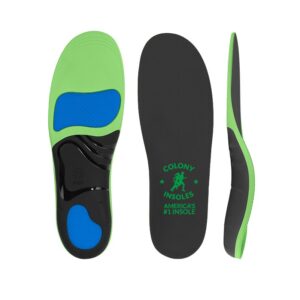 Doctor-Designed Orthotic
Premium Colony Ortho RX
- Recommended by podiatrists
- Memory foam + gel with real arch support
- 60-day money-back guarantee
- Free shipping within the USA
How Orthotic Support Changes the Mechanics
An orthotic insole works by altering the forces that travel through your foot during that gait cycle, rather than by passively cushioning it. A semi-rigid shell under the medial arch resists excessive collapse, while a contoured heel cup cradles the calcaneus and limits the rotational forces transmitted up the chain. The result is a more neutral, better-supported stride that reduces the peak loads driving many lower-limb complaints. In practical terms, a well-designed device helps by:
- Supporting the medial arch to control overpronation and stabilize the foot’s inner column.
- Cupping and centering the heel to ease tension on the plantar fascia and reduce heel pain.
- Redistributing pressure away from overloaded zones, such as the forefoot or a tender heel spur site.
- Filling the gap under a high arch so load is shared rather than concentrated on the heel and ball.
- Improving alignment and shock absorption so muscles and joints work within a more efficient range.
What Orthotics Can and Cannot Do
Honesty matters here. Orthotics do not permanently reshape bones or cure a structural condition, and no insole should promise to. What they do is manage the mechanics that aggravate symptoms, which is why they are a proven conservative tool for ongoing comfort. The level of correction depends on the device: a structured shell delivers real biomechanical support, whereas a soft memory foam or gel insole prioritizes cushioning over control. The two serve different goals.
Who Benefits From Orthotic Support
Orthotic insoles suit people whose feet roll inward, those managing flat feet or high arches, and anyone whose job keeps them standing all day, where cumulative load is the real challenge. They are an educational, low-risk first step, not a substitute for a podiatrist’s evaluation if pain is severe, persistent, or accompanied by numbness. Give a supportive device several weeks of consistent wear to let your body adapt.
Related Orthotics & Guides
- Doctor-designed orthotic insoles for biomechanical support
- Arch support inserts to control pronation
- Insoles for overpronation
- Support for plantar fasciitis and heel pain
- Insoles for flat feet
Frequently Asked Questions
How do orthotics actually work to relieve foot pain?
Orthotics work by changing the forces that travel through your foot as it moves through the gait cycle. A supportive arch and contoured heel cup limit excessive pronation and rotation, distribute pressure more evenly, and improve alignment. This reduces the peak loads on strained tissues and joints, which is what eases day-to-day discomfort.
Do orthotics permanently correct foot problems?
No. Orthotics do not permanently reshape bones or cure structural conditions, and any product claiming to should be treated with caution. They manage the mechanics that aggravate symptoms, so benefits are linked to wearing the device. For most people that means lasting comfort while the insoles are in use, not a permanent structural change.
What is the difference between a supportive orthotic and a cushioned insole?
A structured orthotic uses a semi-rigid shell to control motion and redistribute load, delivering genuine biomechanical support. A soft memory foam or gel insole mainly adds cushioning and shock absorption without controlling how the foot moves. Cushioning feels comfortable, but for pronation control or arch support, a structured device does more.
How long does it take for orthotics to work?
Many people notice relief within the first days to weeks, but the foot and lower limb often need a short adjustment period as muscles adapt to a more neutral alignment. Wearing them consistently helps. If pain worsens or there is no improvement after several weeks of regular wear, see a podiatrist for an evaluation.