The Bruised Knot Tucked Behind Your Toes
Ball-of-foot pain carries an unmistakable fingerprint: a scalding, tender knot just behind the toes, like a pebble wedged permanently under the forefoot. It ranks among the complaints we field most, and clinically it usually comes down to the metatarsal heads absorbing more load than the cushioning tissue around them can comfortably handle. For most folks it surfaces after a long stretch upright or a run of days in flimsy-soled shoes, and it converts every toe-off into a moment you flinch through.
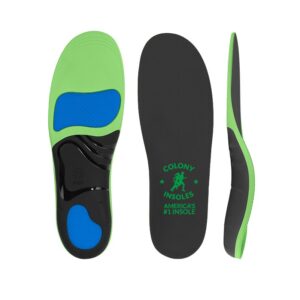 Doctor-Designed Orthotic
Premium Colony Ortho RX
- Recommended by podiatrists
- Memory foam + gel with real arch support
- 60-day money-back guarantee
- Free shipping within the USA
Why the Forefoot Soaks Up the Punishment
The ball of the foot already shoulders a hefty fraction of your weight, and it labors hardest at the instant of propulsion when you launch into the next stride. If the arch is not pulling its share of that load, force drifts forward and concentrates over the metatarsal heads, and the protective fat pad meant to buffer them gets overrun. Set that on a hard floor inside a flat shoe and you get the deep, gnawing burn beneath the forefoot. Spread the pressure back out and the whole equation shifts, which is exactly the job this orthotic is engineered to do.
Lifting the Load Off the Metatarsals
The insole opens with a cushioning stratum of memory foam and gel that pads the forefoot right where it scorches and damps the shock of each contact. Just as critical, the structured arch support ushers load back across the full footprint instead of letting it stack under the metatarsal heads. Colony Ortho RX is podiatrist-designed, and for this pattern it is that pairing, metatarsal offloading alongside arch support, that hands the forefoot a true break.
- Memory foam and gel cushioning set exactly where the forefoot scorches
- Arch support that channels load off the metatarsal heads
- Shock attenuation that dulls hard floors and paper-thin soles
- A trim profile that settles comfortably into everyday shoes
- All-day support for $29
Who This Helps
If it feels like a stone rides under your step, if standing all day leaves the forefoot pounding, or if dress shoes and trainers alike leave you raw, this is engineered for you. Forefoot pain tends to keep company with other foot trouble, and people who also feel the drag of overpronation or radiating knee pain often find that solid support rebalances the entire foot. Forefoot pain that persists earns a clinician’s assessment rather than guesswork.
Flinching at every step should not be your normal. Try Colony Ortho RX with free U.S. shipping and a 60-day money-back guarantee, and feel the load lift off the forefoot. Put genuine support back beneath your feet.
Related Insoles & Guides
- Shoe Inserts for Ball of Foot Pain
- Insoles for Ball of Foot Pain Relief
- Metatarsal Pad Insoles for Ball-of-Foot Pain
- Shoe Inserts for Foot Pain Relief
- Insoles for Neuropathy Foot Pain
- Shoe Inserts for Foot Pain Relief
Frequently Asked Questions
What is actually causing the hot, pebble-like spot behind my toes?
Clinically, that knot usually traces to the metatarsal heads — the weight-bearing ends of the long foot bones — absorbing more load than the fat pad cushioning them can handle. When the arch is not carrying its share, force drifts forward and concentrates there, and long hours upright or thin-soled shoes push the tissue past what it can comfortably buffer.
How does this insole offload the metatarsal heads rather than just padding them?
Padding helps, but redistribution does the heavier lifting. The structured arch support re-engages the midfoot so it carries its intended share of body weight, pulling concentrated force back off the forefoot. The memory foam and gel layer then cushions what still lands behind the toes and damps the pressure spike of each step. Spreading the load changes the equation; padding alone only softens it.
Will it help with pain that spikes when I push off into a stride?
Toe-off is when the forefoot works hardest; propulsion concentrates load over the metatarsal heads at the exact moment you flinch. By supporting the arch so force is shared across the whole foot, and cushioning the forefoot through that propulsion phase, the insole is aimed directly at that moment. Severe or sharply localized push-off pain still merits a podiatric exam.
When should ball-of-foot pain send me to a doctor instead of an insole?
See a clinician if the pain is sharp and pinpointed to one spot, comes with numbness or tingling in the toes, follows an injury, or keeps worsening despite better support and footwear. Those patterns can signal conditions a general orthotic is not designed to treat. For diffuse, load-related forefoot soreness from hard floors and flat shoes, redistribution and cushioning are reasonable first steps.