The Pebble That’s Always Under the Forefoot
I’m Jack Young, founder of Colony Ortho RX. Metatarsalgia makes you aware of every step. It’s the hot, aching, sometimes sharp pain directly under the ball of the foot — as if a pebble were lodged in the shoe that never clears. I designed our orthotic for people who keep cutting the day short because the forefoot is overloaded by mid-afternoon.
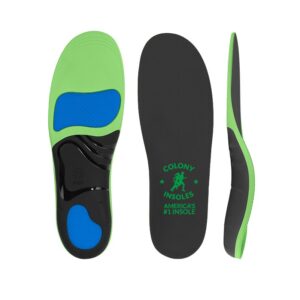 Doctor-Designed Orthotic
Premium Colony Ortho RX
- Recommended by podiatrists
- Memory foam + gel with real arch support
- 60-day money-back guarantee
- Free shipping within the USA
Why the Metatarsal Heads Become Overloaded
The forefoot already absorbs substantial pressure at push-off, and that load climbs when the arch drops or body weight shifts anteriorly onto the toes. Drive more force through the metatarsal heads than the soft tissue beneath them can tolerate and that tissue becomes inflamed and tender. Thin, flat factory liners do nothing to redistribute the load, so it keeps concentrating on the same raw zone hour after hour. Elevated heels, hard flooring, and worn footwear all raise the pressure, and before long you’re supinating onto the lateral border just to find a tolerable step.
How the Orthotic Offloads the Forefoot
Our insole uses a cushioned memory foam and gel platform to redistribute pressure away from the metatarsal heads, while the structured arch support lifts and braces the midfoot so weight stops collapsing anteriorly. The shock-attenuating gel takes the sting out of each step on hard flooring, and the contoured shape encourages a more neutral position so those metatarsal heads finally get relief. It’s a podiatrist-developed design built to support standing, walking, and running with far less forefoot pain.
- Pressure redistribution directly under the metatarsal heads
- Geometric arch support that rebalances load off the forefoot
- Shock-attenuating gel for hard floors and long days
- Low-profile for dress shoes, sneakers, and flats
- One medical-grade pair for $29
Who This Is For
You stand on hard floors all day, you live in heels, you run regularly, or you feel that forefoot burn creep in around midday. Plenty of our customers manage more than one foot condition at once, so look at our shoe inserts for high arches and our insoles for flat feet. The aim stays the same — spread the load, quiet the pain. This is educational, not a diagnosis.
Don’t let the forefoot run your whole day. We ship free across the USA with a 60-day money-back guarantee — feel the difference yourself, or get every penny back. Order a pair and lose the pebble feeling.
Related Insoles & Guides
- Insoles for Metatarsalgia
- Best Shoe Inserts for All-Day Comfort
- Heel Inserts for Heel Pain Relief
- Gel Insoles for Real Shock Absorption
- Height-Boosting Shoe Inserts
- Orthopedic Shoe Inserts
Frequently Asked Questions
Why does it feel like a pebble is permanently lodged under the ball of my foot?
That sensation is the hallmark of metatarsalgia. The soft tissue beneath the metatarsal heads is absorbing more pressure than it can tolerate, so it becomes inflamed and tender, and every step presses directly on the irritated zone. The pebble is not in the shoe; it is concentrated load landing on the same raw spot hour after hour.
How does arch support relieve pain that sits under the forefoot, not the arch?
Because much of that forefoot load arrives from upstream. When the arch drops, body weight collapses anteriorly onto the toes and drives extra force through the metatarsal heads at push-off. Lifting and bracing the midfoot interrupts that shift, while the memory foam and gel platform redistributes whatever pressure remains away from the inflamed tissue.
What daily habits push metatarsal pressure higher?
Three show up constantly: elevated heels, which tip body weight forward onto the forefoot; long hours on hard flooring, which removes any give beneath the metatarsal heads; and worn footwear whose flat liner stopped redistributing load long ago. Each one alone raises forefoot pressure, and combined they keep the same overloaded zone irritated all day.
Is it a problem that I have started walking on the outer edge of my foot?
It is a signal worth taking seriously. Supinating onto the lateral border is a compensation, your gait searching for a step that does not press the tender metatarsal heads, and it can shift strain to new structures over time. Offloading the forefoot removes the reason for the workaround, and pain that persists deserves a clinician’s evaluation.