The Arch Sets the Terms for Everything Above It
The medial longitudinal arch is the keystone of foot biomechanics. When it holds its height under load, the talus stacks cleanly over the calcaneus, the tibia tracks vertically, and ground reaction forces distribute the way the foot was structured to handle them. When the arch collapses, the foot pronates excessively and the kinetic chain compensates upstream — the knee drifts into valgus, the hip rotates, the lumbar spine adjusts. I’m Jack Young, and at Colony Ortho RX we engineer the orthotic outward from the arch deliberately, because controlling that one structure changes the loading pattern of the entire limb.
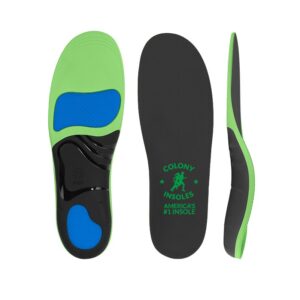 Doctor-Designed Orthotic
Premium Colony Ortho RX
- Recommended by podiatrists
- Memory foam + gel with real arch support
- 60-day money-back guarantee
- Free shipping within the USA
What an Unsupported Arch Does Mechanically
Most footwear ships with a flat sock liner. It finishes the shoe cosmetically and does nothing to resist arch deformation. With every stance phase the arch flattens, the foot rolls medially, and the intrinsic muscles and the posterior tibial tendon work eccentrically just to slow that collapse. Whether your arch is high, low, or neutral, an unsupported foot transfers excess strain to the ankle, knee, and lumbar region. A contoured orthotic that meets the arch through its full length shares that mechanical load, so those stabilizing tissues fatigue less. Most people register that first as reduced end-of-day foot fatigue.
How the Orthotic Is Engineered
We anchor the device with structured, geometric arch support, shaped to retain its contour under full body weight rather than compressing flat within weeks. A layered memory foam and gel top deck adds cushioning and genuine shock attenuation at each footstrike. The design is podiatrist-developed, it conforms to the plantar surface, and it brings medical-grade structural support to standing, walking, and running.
- Geometric arch support engineered to hold its height under load
- Accommodates high, low, and neutral arch types
- Memory foam and gel layered over a firm supportive base
- Improved rearfoot-to-knee alignment through the kinetic chain
- Low-profile enough for most everyday footwear
Who Responds to This Fastest
People on their feet all day. Flexible flatfoot. Those whose arches ache by mid-afternoon, or who finish a shift with the knees and low back complaining louder than the feet. Once the arch is doing its structural job, the strain it was transmitting upstream tends to settle. For pain that presents elsewhere, see our inserts for heel spurs and our inserts for ball of foot pain.
Correct the foundation and the chain above it benefits. Order today with free shipping across the USA and a risk-free 60-day money-back guarantee — if your arches aren’t supported the way they should be, send them back. Try a pair of Colony Ortho RX and feel the difference from the arch up.
Related Insoles & Guides
- Arch Support Shoe Inserts
- High Arch Support Inserts
- Insoles for Pregnancy: Arch & Foot Support
- Insoles for Flat Feet & Arch Support
- Insoles for Skechers: Add Arch Support
- High Arch Support Insoles for Pain Relief
Frequently Asked Questions
Why is the medial longitudinal arch called the keystone of foot mechanics?
Because everything above it organizes around its height. When the arch holds under load, the talus stacks cleanly over the calcaneus, the tibia tracks vertically, and ground reaction forces distribute the way the foot was structured to handle them. Lose that height and the alignment upstream, at the knee, hip, and lumbar spine, has to compensate.
What happens to my knees and back when the arch collapses?
Excess pronation travels up the kinetic chain. As the foot rolls medially, the knee drifts toward valgus, the hip rotates to follow, and the lumbar spine adjusts its posture to keep you balanced. None of those joints is failing on its own; they are compensating for a foundation that stopped holding its shape under load.
Do neutral arches need support, or is this only for flat feet?
Arch type changes the details, not the principle. A flat factory liner resists no deformation, so whatever arch you have flattens with every stance phase while the intrinsic muscles and posterior tibial tendon work eccentrically to slow the collapse. High, low, or neutral, a contoured support shares that load so the stabilizing tissues fatigue less.
How is this orthotic engineered around the arch specifically?
We design outward from the arch deliberately, because controlling that one structure changes the loading pattern of the entire limb. The contour meets the medial longitudinal arch through its full length rather than pressing at one point, resisting deformation through stance so the talus stays stacked, the tibia tracks straight, and less strain transfers to the ankle, knee, and lumbar region.