What Is Morton’s Neuroma?
Morton’s neuroma is a thickening of the tissue surrounding one of the nerves that runs between your metatarsal bones, most often between the third and fourth toes. It develops when that nerve is repeatedly compressed or irritated, leaving you with burning, tingling, numbness, or the classic feeling of a pebble bunched up in the ball of your foot. Some people also notice an electric, shooting sensation that radiates into the toes. Tight shoes, high heels, and high-impact activity tend to make symptoms worse, while standing for long stretches keeps the area under constant load and gives the nerve little chance to recover.
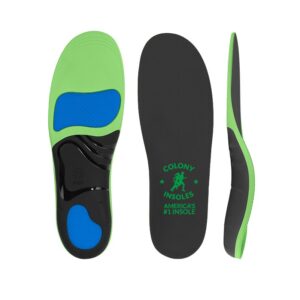 Doctor-Designed Orthotic
Premium Colony Ortho RX
- Recommended by podiatrists
- Memory foam + gel with real arch support
- 60-day money-back guarantee
- Free shipping within the USA
How Orthotic Support Helps Biomechanically
Because the pain comes from mechanical nerve compression, the goal of orthotic insoles is to take pressure off the irritated nerve and spread load more evenly across the forefoot. A doctor-designed orthotic does this through structured support rather than soft padding alone. Cushioning can feel nice underfoot, but on its own it does little to change the forces driving the irritation. By stabilizing the arch and controlling how the foot loads with each step, an orthotic reduces the splaying of the metatarsal heads that pinches the nerve.
- A supportive metatarsal contour helps lift and separate the metatarsal heads, easing direct pressure on the nerve between them.
- Firm arch support limits excess motion, so the forefoot is not overloaded with every stride.
- Controlling overpronation reduces the rolling-inward force that crowds the front of the foot.
- A cushioned gel top layer absorbs impact at the ball of the foot during walking and standing.
- Consistent positioning from shoe to shoe keeps the correction working all day, not just at home.
Who Orthotics Suit
These insoles suit anyone whose forefoot symptoms flare with activity or prolonged weight-bearing, including people who stand all day at work, on the shop floor, or on their feet through a long shift. They tend to help most when paired with roomier, lower-heeled footwear that gives the toes space to spread. Because every foot is different, the right level of support depends on your arch type, your activity, and the shoes you spend the most time in.
A Sensible Part of Your Plan
Orthotic support is best viewed as one piece of a broader management plan that may also include footwear changes, activity adjustments, and guidance from your own clinician. It is not a cure, it will not shrink the neuroma, and it does not replace a proper diagnosis, but for many people consistent daily use makes ordinary steps noticeably more comfortable. If your symptoms are severe, worsening, or not improving, see a podiatrist or physician for evaluation.
Related Orthotics & Guides
- Doctor-designed orthotic insoles
- Structured arch support inserts
- Insoles for overpronation
- Cushioned gel insoles
- Insoles for standing all day
Frequently Asked Questions
Can orthotics cure Morton's neuroma?
No. Orthotics do not cure or shrink the neuroma. They work biomechanically by offloading and spreading pressure across the forefoot, which can reduce nerve compression and make day-to-day walking and standing more comfortable. They are best used as part of a management plan guided by your clinician.
How do orthotic insoles relieve Morton's neuroma pain?
They redistribute load away from the irritated nerve. Firm arch support and pronation control limit the excessive motion and metatarsal splaying that pinch the nerve, while a contoured forefoot and cushioned top layer ease direct pressure on the ball of the foot during each step.
What kind of shoes should I wear with these insoles?
Choose shoes with a wider toe box and a low heel so the metatarsals are not crowded or driven forward. Avoid narrow, pointed, or high-heeled footwear, which increases forefoot compression. The insole works best when the shoe gives it and your foot enough room.
How long before I notice a difference?
Many people feel reduced forefoot pressure quickly, but symptom relief varies from person to person and depends on activity level, footwear, and the severity of the neuroma. Give the insoles consistent daily wear across your shoes, and consult your clinician if pain persists or worsens.