When One Limb Sits Shorter Than the Other
A limb-length discrepancy is more common than most people assume, and many never suspect one until the symptoms surface. The early signs are subtle and mechanical. One iliac crest rides higher than the other. The same side of the lower back tightens by mid-afternoon. One outsole wears faster than its pair. Even a modest discrepancy tilts the pelvis off level, and the resulting strain can travel from the foot through the entire kinetic chain into the spine. Recognizing the pattern is the first step toward managing it.
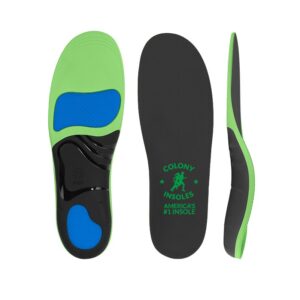 Doctor-Designed Orthotic
Premium Colony Ortho RX
- Recommended by podiatrists
- Memory foam + gel with real arch support
- 60-day money-back guarantee
- Free shipping within the USA
Why a Small Discrepancy Affects So Much
The body functions as a linked kinetic chain, and each segment depends on the alignment of the one below. When one limb sits slightly short, the pelvis drops on that side, the lumbar spine curves to compensate, and the paraspinal muscles on one side work continuously to hold the trunk level. Sustain that compensation over months and the soft tissue fatigues. The discomfort seldom stays in the legs. It presents as lumbar tightness, a cranky hip, or an asymmetrical, tiring gait. Returning the pelvis toward level is the core objective.
How the Orthotic Supports Symmetry
A significant structural discrepancy may require a clinician-prescribed heel lift, and that is worth saying plainly. Many people with a mild functional imbalance, however, gain real relief from consistent, motion-controlling support that smooths the stride. Our insole gives both feet an identical, dependable base, so gait mechanics settle into a more symmetrical pattern. A structured arch profile keeps each foot in better alignment, memory foam evens plantar pressure distribution, and a gel layer attenuates the additional shock an asymmetrical stride sends up into the joints. This is podiatrist-designed, medical-grade support.
- Matched, consistent support under both feet for a more symmetrical stride
- Structured arch support that keeps each foot aligned through stance
- Memory foam that distributes plantar pressure more evenly
- Gel shock attenuation to help protect the hips, knees, and lumbar spine
- Mechanical support that reduces the tendency to favor one side
Who This Suits
Anyone with a mild functional leg-length difference who is tired of feeling lopsided by mid-afternoon. If one side of the body always seems to shoulder the load, give the stride a level, even base to push from. One honest caveat: a true structural discrepancy should be assessed by a clinician, since orthotic cushioning supports mild functional imbalance but does not correct a measured bone-length difference.
If your imbalance presents mainly as lumbar tension, our lower back pain inserts are worth reading, and anyone working on overall alignment should review our supination correction guide. Order your Colony Ortho RX today and feel what a level base does for your gait.
Related Insoles & Guides
- Insoles for Leg Length Discrepancy
- Best Shoe Inserts for All-Day Comfort
- Heel Inserts for Heel Pain Relief
- Gel Insoles for Real Shock Absorption
- Height-Boosting Shoe Inserts
- Orthopedic Shoe Inserts
Frequently Asked Questions
Can shoe inserts really help when one leg is shorter than the other?
It depends on the size and type of discrepancy, and we say that plainly. A significant structural difference may need a clinician-prescribed heel lift. But many apparent discrepancies are functional — one arch collapses more than the other — and stabilizing both feet on matched, supportive geometry helps the pelvis sit closer to level.
What signs suggest my legs might be uneven in the first place?
The clues are mechanical and easy to miss: one iliac crest riding higher, low-back tightness that favors the same side by mid-afternoon, one outsole wearing faster than its mate, or a gait that feels asymmetrical and tiring. Many people carry a modest discrepancy for years without suspecting it until those patterns accumulate.
Why does a small leg-length difference end up hurting my lower back?
The body is a linked kinetic chain. When one limb sits short, the pelvis drops on that side, the lumbar spine curves to compensate, and the paraspinal muscles on one side work continuously to hold the trunk level. Months of that one-sided effort fatigue the soft tissue, which is why the complaint often surfaces as lumbar tightness rather than leg pain.
Should I wear the insole in both shoes or just the shorter side?
Both. The goal is a matched, stable platform under each foot so neither arch collapses unevenly and the pelvis is not tilted further by the footwear itself. The insoles come as a trim-to-fit pair; cut them to your shoe size and wear them together. If a clinician has prescribed a unilateral heel lift, follow that guidance first.