When the Lower Back Never Fully Settles
Lower back pain bleeds into everything: sitting through a meeting, standing at the sink, shifting at 2 a.m. for a position that does not ache. What surprises most people is where the search should start, which is often not the back at all, but the feet. The foot is where standing posture begins, and small deviations there propagate upward through the kinetic chain.
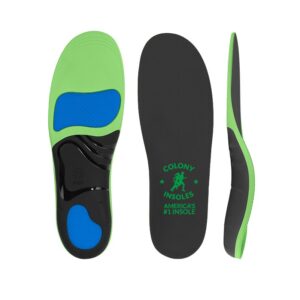 Doctor-Designed Orthotic
Premium Colony Ortho RX
- Recommended by podiatrists
- Memory foam + gel with real arch support
- 60-day money-back guarantee
- Free shipping within the USA
Why the Trouble Starts at the Floor
Picture a building on a foundation tilted a few degrees. Nothing collapses, but every floor above leans slightly to stay level. The body behaves similarly. When the arches flatten and the feet roll out of alignment, the pelvis and spine quietly adjust to keep you upright, and that daily postural compromise is what the lower back registers by evening. Stand on a concrete floor with no shock attenuation for eight hours and the impact loading compounds the strain.
How We Support You From the Ground Up
We designed the orthotic around a structured arch support that holds the foot in a more neutral, stable position, giving the alignment above it a fair starting point. Layered over that, memory foam and gel attenuate the impact of each step before it can travel up the spine. Colony Ortho RX is podiatrist-designed, and the foot is one of the most overlooked levers for taking load off a fatigued back.
- Geometric arch support that encourages balanced, upright posture
- Gel cushioning that attenuates impact before it reaches the spine
- Memory foam that stays supportive through a full day on your feet
- Fits work shoes, sneakers, and boots, so the support follows you
- Foundation-first support for $29
Who This Helps Most
If you stand or walk for a living, if hard floors leave your back stiff by closing time, or if you have addressed everything except the feet, start here. Back pain often sits at the top of a chain. Those who also manage radiating knee pain, or who suspect overpronation, often find that steadying the base brings relief further up. This is educational guidance, not a diagnosis, and ongoing back pain should be assessed by a clinician.
Your back works hard enough. Give it a stable place to stand. Try Colony Ortho RX with free U.S. shipping and a 60-day money-back guarantee. If you do not stand a little taller and ache a little less, send them back. Start from the ground up.
Related Insoles & Guides
- Shoe Inserts for Back of Heel Pain
- Insoles for Back Pain Relief
- Insoles for Lower Back Pain Relief
- Heel Inserts for Heel Pain Relief
- Shoe Inserts for Ball of Foot Pain
- Insoles for Ball of Foot Pain
Frequently Asked Questions
Why would shoe inserts help a problem in my lower back?
Because standing posture is built from the ground up. When the arches flatten and the feet roll out of alignment, the pelvis and spine make small ongoing adjustments to stay level, and the lower back absorbs that compromise all day. Supporting the arch gives the joints above it a more neutral starting point, addressing one common mechanical contributor to back strain.
How does the insole change what my spine absorbs when I stand on concrete all day?
Hard flooring offers little shock attenuation of its own, so over a long shift the impact loading of each step compounds. The insole pairs memory foam with a gel layer to absorb that force at foot level, before it travels up the kinetic chain, while the structured arch holds your foot in a steadier position for standing.
Can a few degrees of arch collapse really change posture enough to matter?
Think of a building on a slightly tilted foundation: nothing collapses, but every level above leans to compensate. Flattened arches work the same way. The knees, pelvis, and spine each make small accommodations, and by evening the lower back has been managing that lean through thousands of steps and hours of standing.
What should I realistically expect an insole to do for back pain?
An orthotic addresses the mechanical share of the problem: foot alignment and impact loading. If your pain stems partly from those, better support from the ground up can help; it will not resolve causes unrelated to gait or posture. Persistent or worsening back pain deserves a clinician’s evaluation, and the 60-day return window gives you room to judge results in your own routine.