Pain at the metatarsal heads
You know the location. A hot, aching pressure just behind the toes that intensifies the longer you stay upright. Many people describe it as walking on a folded sock or a small stone that never clears. That region, the forefoot at the metatarsal heads, is a common site of overload, and the relief comes not from padding alone but from changing how the foot distributes weight before it ever reaches that tender zone.
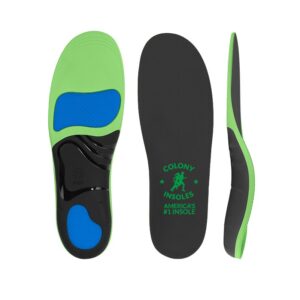 Doctor-Designed Orthotic
Premium Colony Ortho RX
- Recommended by podiatrists
- Memory foam + gel with real arch support
- 60-day money-back guarantee
- Free shipping within the USA
Why the forefoot takes the overload
The ball of the foot carries a large share of bodyweight through propulsion on every step. When the medial arch loses support, or the natural plantar fat pad thins with age and mileage, pressure funnels into a small area over the metatarsal heads. Hard floors, thin outsoles, and prolonged standing sharpen the load further. Effective management means metatarsal offloading: get the arch to carry and spread the load so the forefoot isn’t left absorbing it alone.
How this footbed offloads the forefoot
This insole pairs memory foam over a gel base, so the forefoot finally gets responsive cushioning under the metatarsal heads. Just as important, the structured geometric arch support lifts and stabilizes the midfoot so weight redistributes rather than stacking on one painful point. The two work together to attenuate impact from heel strike through toe-off. People on concrete all day tell us the difference is most noticeable by hour nine, exactly when the load used to peak.
- Targeted gel cushioning under the metatarsal heads
- Firm, contoured arch support that offloads the forefoot
- Memory foam that conforms to your plantar shape over a few wears
- Shock attenuation on concrete, tile, and other hard surfaces
- Built to a standard podiatrists are comfortable recommending
Who this suits
If you stand all day, keep up a morning walk, or want an evening out without that nagging forefoot ache, this footbed addresses the mechanism. Many people who come to us for forefoot relief also look at our support for high heels and our help for running, since the same pressure point shows up in both.
Forefoot overload responds to better load distribution, not just more foam. Give the metatarsal heads orthotic offloading designed by people who understand the mechanics. Get a pair of Colony Ortho RX insoles.
Related Insoles & Guides
- Metatarsal Pad Insoles for Ball-of-Foot Pain
- Shoe Inserts for Foot Pain Relief
- Shoe Inserts for Ball of Foot Pain
- Insoles for Ball of Foot Pain
- Shoe Inserts for Foot Pain Relief
- High Arch Support Insoles for Pain Relief
Frequently Asked Questions
How does supporting my arch relieve pain that sits under the ball of my foot?
Because the overload starts upstream. When the medial arch stops carrying its share, bodyweight funnels forward and stacks on the metatarsal heads through propulsion. Lifting and stabilizing the midfoot lets the arch spread that load across the whole plantar surface, so less pressure ever reaches the tender zone behind your toes. The cushioning helps; the redistribution does the heavier lifting.
Why isn't a simple gel pad under the forefoot enough?
A pad changes what the metatarsal heads land on, not how much they carry. If pressure keeps funneling into the same small area through a thinned fat pad, an unsupported arch, and hard floors, you are cushioning an overload instead of correcting it. Effective metatarsal offloading pairs forefoot cushioning with a structured arch that redistributes weight first.
What makes the ball of the foot hurt more with age and mileage?
The natural plantar fat pad under the metatarsal heads thins with age and accumulated mileage, so the same steps land with less built-in padding. Add hard floors, thin outsoles, or long hours standing and pressure concentrates further. An insole with memory foam over a gel base restores a cushioned interface there while the arch support takes back its share of load.
When should ball-of-foot pain be evaluated by a clinician instead?
If the pain is sharp and localized between specific toes, comes with numbness or tingling, follows an injury, or persists despite offloading and footwear changes, have a podiatrist examine it; conditions like a neuroma or stress fracture need diagnosis, not just an insole. These insoles address mechanical overload at the metatarsal heads and are not a substitute for an exam.