Stand in front of any pharmacy insole display and the choice paralysis is immediate: rows of foam inserts sorted by activity, pressure point, or vague promise, with nothing telling you what your particular foot mechanics require. Colony Ortho RX approaches the problem from the opposite direction, building a single biomechanically corrective device rather than asking you to self-diagnose at a shelf.
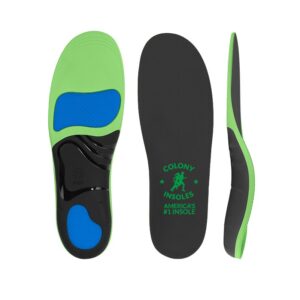 Doctor-Designed Orthotic
Premium Colony Ortho RX
- Recommended by podiatrists
- Memory foam + gel with real arch support
- 60-day money-back guarantee
- Free shipping within the USA
Cushioning Density Versus Postural Control
Drugstore favorites like Dr. Scholl’s win on accessibility, and a soft EVA pad does feel pleasant for the first few strides. The mechanical limitation shows up under load: compliant foam compresses and stays compressed, so the medial longitudinal arch loses its scaffold, the rearfoot drifts into excess pronation, and the plantar fascia absorbs strain it was never meant to carry alone. A flat cushion treats sensation; it does not redistribute force. Our build instead anchors the foot with a contoured rigid shell that resists collapse, then tops it with a memory foam and gel interface for tissue comfort.
Why Alignment Has To Come First
When the calcaneus sits in a neutral position, the talus, midfoot, and forefoot stack in a more efficient column, and the muscles of the lower leg fire less to keep you upright. That is the clinical reasoning behind orthotic geometry: control the position of the rearfoot and the rest of the kinetic chain settles. Soft inserts skip this step entirely. A structured device manages motion through the gait cycle, while the cushioning layer attenuates the impact spike at heel strike.
What separates an orthotic from a pharmacy pad:
- Pronation management from a load-bearing arch contour, not foam that flattens by mid-shift.
- Heel-strike shock attenuation that helps spare the ankles, knees, and lumbar spine.
- Forefoot offloading for those carrying pressure across the metatarsal heads.
- Podiatrist-recommended design intended for standing, walking, and running demands.
- Free U.S. delivery and a return window that pharmacy clamshells never offer.
Judge It On Your Own Feet
An insole pulled from a blister pack belongs to you the instant it is opened, refund unlikely. We extend a genuine evaluation period so you can run Colony Ortho RX through double shifts, weekend errands, and training sessions before deciding. Still weighing options? Look at Colony Ortho RX vs Superfeet, or review support strategies for those who work on their feet around heel and plantar fascia pain. An orthotic supports the foot; it is not a diagnosis, so see a podiatrist for any persistent condition.
Built for people who log the most hours upright, Colony Ortho RX pairs corrective structure with impact control and ships with a satisfaction guarantee. Give it a real week under genuine load, and if your feet are not noticeably steadier, return it. Order a pair and place medical-grade orthotic support beneath every stride.
Frequently Asked Questions
Why does a soft drugstore insert feel good at first, then stop helping?
Compliant EVA foam feels pleasant for the first strides because it cushions sensation. Under sustained load it compresses and stays compressed, so the medial longitudinal arch loses its scaffold, the rearfoot drifts into excess pronation, and the plantar fascia absorbs strain it was never meant to carry alone. Padding fades; the force-distribution problem underneath it never got addressed.
What changes in my body when the rearfoot is held closer to neutral?
With the calcaneus near neutral, the talus, midfoot, and forefoot stack into a more efficient column. Load travels up that aligned column instead of leaking into collapse, and the lower-leg muscles fire less just to keep you upright. That is why correction is sequenced before cushioning: alignment fixes the load path, then the foam and gel layer manages tissue comfort.
How am I supposed to pick from a pharmacy wall sorted by activity and pressure point?
That wall asks you to self-diagnose, which is exactly the step we removed. Those categories sort by symptom location, while many common overload complaints share the same mechanics: an unsupported arch and a rearfoot drifting out of alignment. Colony Ortho RX addresses that root with one biomechanically corrective device — a contoured shell that resists collapse under a foam and gel interface.
When is it time to move past a flat cushion to a corrective insole?
A reasonable cue is relief that keeps shrinking: the pad feels fine early, yet arch fatigue or heel strain still builds with hours on your feet. That pattern suggests the issue is force distribution and alignment, which cushioning alone cannot redistribute. A device that supports the arch and steadies the rearfoot targets that mechanism — and pain that persists or worsens deserves a clinician’s evaluation.