Running loads the foot harder than walking ever does
At footstrike, the running foot absorbs ground reaction forces that reach several multiples of bodyweight, and that loading cycle repeats with every stride for the length of your run. The structures asked to manage it are the plantar fascia, the heel fat pad, and the arch as a whole. Run on the same tissues three or four times a week and cumulative load, not a single injury, is usually what produces the arch and heel soreness runners describe. Colony Ortho RX approaches this as a biomechanics problem first.
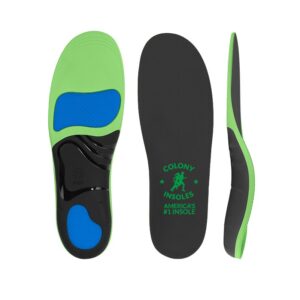 Doctor-Designed Orthotic
Premium Colony Ortho RX
- Recommended by podiatrists
- Memory foam + gel with real arch support
- 60-day money-back guarantee
- Free shipping within the USA
Why a flat factory liner offers little structural support
The thin foam liner inside most running shoes finishes the fit of the shoe; it does not control motion. It does little to limit how far the arch lowers under load, which means excessive pronation goes largely unchecked through midstance. It also attenuates very little shock. Over distance, an unsupported arch keeps elongating the plantar fascia at each step, and that repeated tension at the heel is a recognised mechanism behind plantar heel pain. Inadequate cushioning leaves the heel fat pad managing impact on its own.
How a structured orthotic changes the loading pattern
This insole is engineered to address rearfoot and midfoot mechanics under repeated impact. A gel base beneath a memory-foam top layer attenuates shock at heelstrike, reducing the peak force transmitted upward through the kinetic chain. The structured geometric arch shell supports the medial longitudinal arch through midstance, helping control the degree of pronation and steadying the foot before toe-off. By limiting how far the arch collapses, the design helps moderate plantar fascia strain across the run. The shell is built to hold its shape, so the support present at mile one is still working at mile six.
- Gel and memory foam that attenuate repeated running impact at heelstrike
- A geometric arch shell that supports the medial arch and helps control pronation through midstance
- Reduced plantar fascia and heel loading as mileage accumulates
- Resilient cushioning that resists bottoming out across long runs
- Built to a standard podiatrists are comfortable recommending
Who benefits from this support
New runners, weekend distance runners, and anyone logging regular morning miles all subject the foot to the same load pattern, and all benefit from structured support rather than a disposable liner. Runners who reach for these often also look at our relief for ball of foot pain when forefoot loading becomes the issue, or fit a pair into everyday Skechers for walking days between runs. This is education on managing foot mechanics, not a diagnosis or a promise of cure.
If arch and heel fatigue is cutting your runs short, structured support is worth trialling. A pair is $29, ships free across the USA, and carries a 60-day money-back guarantee. Put real mileage on them, and if your feet do not respond, return them for a full refund. Run on a supportive pair and let your mechanics, not soreness, decide the distance.
Related Insoles & Guides
- High Arch Support Insoles for Pain Relief
- Heel Support Insoles for Heel Pain Relief
- Heel Inserts for Heel Pain Relief
- Heel Cups for Heel Pain Relief
- High Arch Insoles for All-Day Comfort
- Insoles for Skechers: Add Arch Support
Frequently Asked Questions
What makes running so much harder on my arches and heels than walking?
At footstrike the foot absorbs ground reaction forces reaching several multiples of bodyweight, and that cycle repeats every stride for the length of the run. The plantar fascia, heel fat pad, and arch manage it all. Run three or four times a week and cumulative load — not one bad step — is usually what produces the soreness runners describe.
Doesn't the liner that came in my running shoes already do this job?
No — a factory liner finishes the fit of the shoe; it does not control motion. It barely limits how far the arch lowers under load, so excessive pronation runs largely unchecked through midstance, and it attenuates very little shock, leaving the heel fat pad to manage impact on its own. A structured orthotic is built for both jobs.
How could supporting the arch reduce pain at my heel?
Through the plantar fascia. When an unsupported arch elongates under load at every step, repeated tension pulls on the fascia at its heel attachment — a recognized mechanism behind plantar heel pain. By limiting arch descent through midstance, the shell reduces how much that tissue is stretched on each of the thousands of strides in a run.
Can I swap it straight in for my shoe's stock insole before a run?
Yes. Lift out the factory liner, use it as a template to trim the orthotic to size, and seat the new footbed flat in the shoe. Give it a few easy runs before any long efforts so your feet adapt to the changed rearfoot and midfoot mechanics under repeated impact.