Why a half-size of slack changes your mechanics
A shoe that runs large does more than feel sloppy. When the upper can’t hold your foot, the foot translates forward inside the shoe on every heel strike and slides back at toe-off. That extra movement means your rearfoot is never seated against the heel counter, so the structures that should be controlling motion spend the day chasing a moving target. The result is friction at the heel and forefoot, reactive toe-clawing as the flexors grip to stabilize, and a guarded, shortened stride. Colony Ortho RX was designed by clinicians to take up that volume and re-establish a stable foot-to-shoe interface, so your mechanics stop fighting the fit.
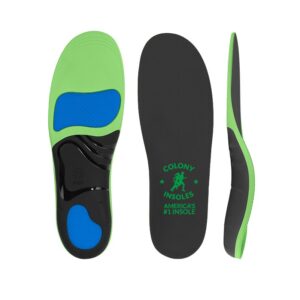 Doctor-Designed Orthotic
Premium Colony Ortho RX
- Recommended by podiatrists
- Memory foam + gel with real arch support
- 60-day money-back guarantee
- Free shipping within the USA
What the empty volume does to your foot
Unfilled depth inside a shoe leaves the foot unanchored through the gait cycle. It shifts forward on descent, shears at the heel on stairs, and recruits the toe flexors to hold position — work those muscles were never meant to do continuously. That repetitive shear is what raises blisters and drives early fatigue, because energy that should go into propulsion is diverted into simply keeping the foot in place. The usual fixes — tissue in the toe box, doubled socks — add bulk without structure. They migrate, compress unevenly, and leave the arch and rearfoot just as unsupported as before. Closing the gap properly takes a contoured layer with genuine volume and a defined arch profile.
How the orthotic closes the gap and seats the heel
Our insole adds a contoured memory foam and gel layer that occupies the excess depth and conforms to the plantar surface, so the slack disappears and forward translation is checked. Beneath it, a structured, geometric arch supports the medial longitudinal arch and seats the rearfoot, controlling the slide before it begins. You gain a more secure fit alongside real shock attenuation at heel strike. This is podiatrist-designed orthotic support that lets you stand, walk, and run without the shoe working against your gait.
- Fills excess volume to restore a stable foot-to-shoe interface
- Memory foam that conforms to your plantar contours
- Geometric arch support that seats the rearfoot and limits forward translation
- Gel cushioning that attenuates impact at heel strike
- One medical-grade pair for $29
Who tends to need this
A shoe that runs half a size large, an online fit that didn’t match the chart, or a foot that simply needs to be locked into proper position. If added height is also part of the goal, our shoe insert lifts are worth reviewing, and if structural support is the priority, see our arch support insoles.
A sizing mismatch is no reason to retire a good pair of shoes. We ship free across the USA and stand behind every order with a 60-day money-back guarantee. Order a pair and correct the fit.
Related Insoles & Guides
- Shoe Inserts for Shoes Too Big
- Inserts to Make Big Shoes Fit
- Insoles for Big Toe Joint Pain
- Insoles for Shoes Too Big
- Best Shoe Inserts for All-Day Comfort
- Heel Inserts for Heel Pain Relief
Frequently Asked Questions
What is mechanically going wrong when my foot moves around inside a large shoe?
On every heel strike the foot translates forward inside the shoe, then slides back at toe-off, so the rearfoot never seats against the heel counter. The structures that should be controlling motion spend the day chasing a moving target. That shows up as shear at the heel, friction at the forefoot, reactive toe-clawing, and a guarded, shortened stride.
Why won't doubled socks or tissue in the toe box fix a shoe that runs big?
They add bulk without structure. Stuffed material migrates, compresses unevenly, and leaves the arch and rearfoot just as unsupported as before — the foot is wedged, not anchored. A clinician-designed insole instead fills the unfilled depth with a contoured platform, so the foot stays seated through the gait cycle rather than held by padding that shifts by mid-morning.
How does re-seating the rearfoot cut down on blisters and end-of-day fatigue?
Blisters are a shear injury — skin rubbing as the foot shifts inside the shoe — and the fatigue comes from energy diverted into gripping instead of propulsion. Once the insole takes up the surplus volume, the heel stays engaged against the counter, shear drops, and the toe flexors release their continuous clench. The same steps cost less and rub less.
Do I trim the insole to match the oversized shoe or my actual foot length?
Trim to the shoe — pull out the factory liner and use it as the cutting template so the insole lies flat without buckling. Your foot then registers against the insole’s contoured support rather than the shoe’s excess length, which is the goal: a stable foot-to-shoe interface re-established inside footwear that runs large.