Sore Feet Often Trace Back to the Footbed
When your feet ache by evening, the shoe itself is frequently not the issue. What sits inside it is. Colony Ortho RX builds its memory foam insoles to conform to the contours of the foot, attenuate the impact of each step, and distribute contact pressure evenly from morning through the end of the day. The aim is mechanical comfort that holds up under hours of weight-bearing, not a cushion that feels nice for an afternoon and then packs flat.
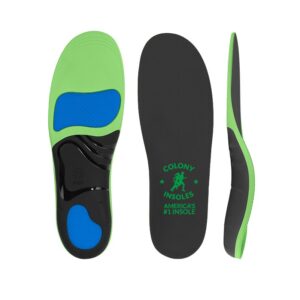 Doctor-Designed Orthotic
Premium Colony Ortho RX
- Recommended by podiatrists
- Memory foam + gel with real arch support
- 60-day money-back guarantee
- Free shipping within the USA
Why Density Matters for Support
Ordinary foam compresses and loses its rebound within a few weeks. Higher-density memory foam responds to body heat and load, conforming to the shape of your arch, heel, and forefoot, then recovering for the next stride. Rather than driving load into the same two regions all day, it spreads contact pressure across a broader surface. That redistribution is what reduces focal fatigue, and it is the difference you notice by mid-afternoon.
What Your Feet Will Actually Register
- Sustained cushioning that resists packing flat after a week of wear
- Shock attenuation that reduces impact reaching the heels, knees, hips, and lower back
- A conforming, contoured fit without the cost or wait of a custom-cast orthotic
- Less focal fatigue when you stand, walk, or work a full shift
Cushioning Paired With Real Structure
Soft foam alone is only half the equation. We pair the memory foam with a gel layer and a structured arch shell, so you get cushioning and alignment. The foam feels supportive the moment you slip it in, while the geometry underneath supports the arch and controls how the foot loads hour after hour. It is the combination podiatrists recommend, and the reason customers on their feet all day report standing, walking, and running with better-managed load.
Who This Supports
Anyone who ends the day with sore feet: nurses pacing a ward, teachers on a hard classroom floor, retail and warehouse crews, runners, weekend walkers. If thin drugstore inserts have never changed how your feet feel, memory foam over a real arch structure is the upgrade worth trying. Want a firmer feel underfoot? Compare our gel insoles and our dedicated arch support inserts.
This is general education on foot mechanics, not personal medical advice. Every order ships free within the USA and carries our 60-day money-back guarantee. Shop Colony Ortho RX for $29.
Related Insoles & Guides
- Memory Foam Insoles
- Comfortable, Durable EVA Foam Insoles
- Best Insoles for Nike Shoes
- Orthopedic Insoles
- Powerstep Alternative
- Superfeet Insole Alternative
Frequently Asked Questions
Why does higher-density memory foam hold up when ordinary foam packs flat?
Ordinary low-density foam takes a compression set — after enough loading cycles its cells stay crushed and the rebound is gone, often within weeks. Higher-density memory foam responds to body heat and load, conforms to the arch, heel, and forefoot, then recovers for the next stride. That recovery cycle is what keeps the cushioning depth intact across months rather than days.
How does spreading contact pressure translate into less end-of-day soreness?
On a flat footbed, ground reaction force concentrates under the heel and metatarsal heads — two small regions absorbing your full weight step after step. A conforming surface enlarges the contact area, so the same load is divided across more tissue. Lower pressure at any single point means less focal fatigue accumulating through a shift of standing and walking.
Does memory foam by itself give the arch enough support?
Conforming foam equalizes pressure, but on its own it deflects under body weight rather than bracing the medial arch. That is why Colony Ortho RX layers its memory foam over structured, geometric arch support: the contour carries arch load and steadies alignment through stance, while the foam handles surface pressure and impact. Each material does the job it is suited for.
When will the insole feel fully formed to my foot?
The foam responds to body heat and pressure, so the contour personalizes over your first several wears rather than on day one. Most of that settling happens during normal walking and standing — no special procedure needed. If your previous insoles were flat, start with a few shorter sessions; new contact under the arch can feel unfamiliar before it feels supportive.