Ask any floor nurse where a double shift settles by the end and the order almost never changes: the feet go first, the lower back follows. Twelve hours on hospital tile can clear 18,000 steps, much of it spent in static stance at a bedside or charting at a med cart. Prolonged standing is its own distinct biomechanical load, and the people who spend the day looking after everyone else tend to look after their own feet last.
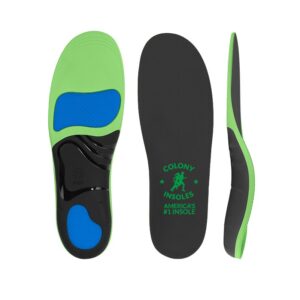 Doctor-Designed Orthotic
Premium Colony Ortho RX
- Recommended by podiatrists
- Memory foam + gel with real arch support
- 60-day money-back guarantee
- Free shipping within the USA
The fatigue that creeps in around hour six has a mechanical cause. Hospital floors are poured concrete beneath a thin vinyl skin, an unforgiving surface that hands back nearly all of the force you press into it. The stock liner in most clogs and nursing shoes is a flat foam wafer that compresses within a couple of weeks. Once it bottoms out, the plantar fascia and arch are left to manage repeated ground reaction forces alone, the arch starts to flatten under sustained load, and the knees, hips, and lumbar spine absorb whatever the foot can no longer dissipate.
Engineered for sustained standing load
Colony Ortho RX is built for exactly this demand. The memory foam and gel bed is designed to keep its supportive structure deep into the shift rather than packing flat before your first break. The structured arch support resists the arch collapse that prolonged standing drives, restraining the inward overpronation behind much of that dragging, end-of-shift heaviness. The shock attenuation reduces the impact routed through the heel and up the kinetic chain every time a call light sends you down the corridor.
Who this serves
Nurses, CNAs, techs, anyone in scrubs who lives in their shoes from clock-in to clock-out. Clinicians who consistently work the floor report that the difference registers on the first shift, usually right around the point where their feet would normally begin to burn.
- Cushioning that holds its structure across a full twelve-hour shift
- Arch support that counters fatigue from sustained standing load
- Shock attenuation that spares heels, knees, and lumbar spine on hard floors
- Podiatrist-designed, medical-grade orthotic construction in a single $29 pair
- Free U.S. shipping and a 60-day money-back guarantee
Drop them in and go
The same mechanics help anyone whose job keeps them vertical. For the full breakdown, read our guide to insoles for standing all day, and if your arches tend to drop by the end of a shift, our notes on insoles for flat feet are worth a few minutes. They match the footprint of the liner already in your shoes, so there is no break-in period and no adjustment phase. Pull the old one, seat these, and lace up.
You give a great deal of yourself every shift. Give your feet support that lets you clock out still steady on them. At $29 a pair with 60 days to reassess, it is a small change that reshapes a long day. Get a pair of Colony Ortho RX before your next shift.
Frequently Asked Questions
What makes hospital floors so punishing over a 12-hour shift?
Hospital flooring is poured concrete under a thin vinyl skin, so it returns nearly all of the force you press into it. Across a shift that can clear 18,000 steps plus long static stretches at the bedside, that unabsorbed ground reaction force loads the plantar fascia and arch repeatedly, which is why fatigue builds even on routine days.
Will Colony Ortho RX fit inside nursing clogs?
Yes. The insole is trim-to-fit: pull out the flat factory liner most clogs and nursing shoes ship with, use it as a cutting template, and seat the orthotic in its place. Removing that liner first frees up the depth the contoured arch needs, so the fit stays secure in closed-back and slip-on styles alike.
How is this different from the foam liner my shoes came with?
Stock liners are flat foam wafers that compress within a couple of weeks, leaving the arch to manage ground reaction forces alone. Colony Ortho RX pairs memory foam with a resilient gel bed engineered to hold its supportive structure deep into a shift, and adds a structured arch that resists the flattening prolonged standing produces.
Can supporting my feet actually ease end-of-shift lower back ache?
It can help mechanically. Whatever force the foot fails to dissipate is absorbed further up by the knees, hips, and lumbar spine. By holding the arch against sustained-load collapse and attenuating shock at the surface, the insole reduces the load passed up that chain. Persistent back pain still deserves a clinician’s evaluation rather than an insole alone.