When the shoe wins and the foot loses ground
Half a size of extra length sounds harmless until you start moving in it. We hear from people who grabbed the only pair left on the rack, inherited work boots that never quite matched, or kept a favorite leather pair that relaxed wider over the years. Whatever the backstory, the engineering issue is identical: the foot is swimming in interior volume it cannot fill on its own, and that empty space sabotages every phase of the gait cycle from heel contact onward.
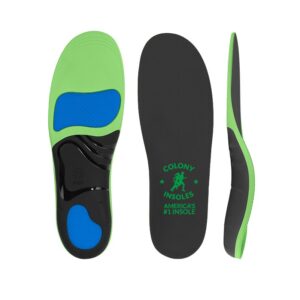 Doctor-Designed Orthotic
Premium Colony Ortho RX
- Recommended by podiatrists
- Memory foam + gel with real arch support
- 60-day money-back guarantee
- Free shipping within the USA
The cascade an oversized shoe sets off
Picture the foot inside a roomy shoe at heel strike. With nothing pinning it in place, it pitches forward toward the toe box on each loading response and drifts laterally when you cut or pivot. The toes answer by flexing hard to grip the floor, a clawing reflex that fires the long flexors when they ought to be quiet and robs the propulsive phase of a square, powerful toe-off. The downstream tab shows up as hot spots and friction blisters at the heel, plus a shortened, defensive stride your hips and knees end up absorbing.
The fix: substance, not a spacer
Reclaiming that volume calls for an orthotic with real mass, not a paper-thin shim. Layers of memory foam and gel occupy the dead space so the foot stops sliding and pivoting against the shoe walls, and a structured arch registers the rearfoot over the heel and holds that position throughout stance. Two outcomes land at once: the foot is finally locked into a repeatable position, and ground reaction is attenuated through the whole working day. The part that tends to surprise people is the newfound steadiness once the wobble disappears and the midfoot is actually braced.
- Genuine thickness that takes up a shoe running a half to full size long
- Halts the anterior creep and lateral drift that derail your gait
- Structured arch that registers and stabilizes the rearfoot in stance
- Layered memory foam and gel that sustain support across a full shift
- Re-establishes a square platform for confident toe-off in roomy shoes
Worth a look if
This is the structural remedy for anyone resorting to doubled socks or a tissue wad jammed up front. When the gap is small, only a touch of looseness rather than a whole size, our companion piece on insoles to make shoes smaller walks through tuning the exact amount of fill, and overpronators reading along may also want our notes on insoles for low arches.
Don’t sideline shoes you actually wear over a number on the box. Put Colony Ortho RX to the test risk-free for 60 days with free shipping across the USA. Should the hold and support fall short, you are refunded in full. Order your Colony Ortho RX and make that loose pair perform like it fits.
Related Insoles & Guides
- Shoe Inserts for Shoes Too Big
- Shoe Inserts for Big Shoes
- Inserts to Make Big Shoes Fit
- Insoles for Big Toe Joint Pain
- Best Insoles for Nike Shoes
- Orthopedic Insoles
Frequently Asked Questions
How does an insole stop my foot from sliding in a half-size-too-big shoe?
An oversized shoe leaves interior volume your foot cannot fill, so it pitches forward at each loading response and drifts sideways when you cut or pivot. A full-length orthotic with genuine thickness — layered memory foam and gel over a structured base — occupies that dead space from beneath, seating the heel and midfoot so they stop sliding against the shoe walls.
Why won't heel grips or a thin liner fix the same problem?
Thin shims and stick-on grips address one contact point while the rest of the foot keeps swimming. The problem is volume, and volume needs substance: a footbed with real mass raises the foot evenly, restores contact across the whole plantar surface, and adds arch structure a flat spacer never provides. Half-measures usually just relocate the friction.
Can filling the dead space stop toe-clawing and heel blisters?
Those two complaints share a cause. When the foot slides, the toes flex hard to grip the floor — a clawing reflex that fires the long flexor muscles when they should be quiet — while the heel rubs itself into hot spots. Once the foot is seated, the gripping reflex has nothing to react to and the repetitive friction behind those blisters is reduced.
When is a shoe too big for any insole to rescue?
An insole reclaims volume, not length. Around a half size of extra room — the loose work boot, the leather pair that relaxed over the years — is realistic territory, and the trim-to-fit outline lets you match the footprint exactly. If a shoe is so long that it flexes well behind your toe joints, no footbed can move that crease, and sizing down is the honest fix.