Understanding Bunions and Hallux Valgus
A bunion, known clinically as hallux valgus, is a progressive deformity in which the big toe drifts toward the lesser toes while the joint at its base, the first metatarsophalangeal joint, enlarges and angles outward. The visible bump is only part of the picture. Underneath, the first metatarsal shifts out of position and the joint becomes unstable, which is why bunions tend to worsen over time and commonly cause pain, redness, swelling, and difficulty fitting comfortably into shoes. While genetics and narrow footwear contribute, abnormal foot mechanics are a major factor in how quickly a bunion advances and how much discomfort it produces along the way.
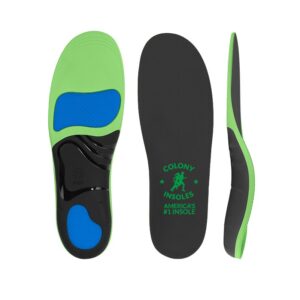 Doctor-Designed Orthotic
Premium Colony Ortho RX
- Recommended by podiatrists
- Memory foam + gel with real arch support
- 60-day money-back guarantee
- Free shipping within the USA
How Orthotic Support Helps Biomechanically
Orthotics do not realign the bones of an established bunion, and no insole should claim to reverse the deformity. What a well-designed pair of orthotic insoles can do is address the underlying mechanics that repeatedly overload the big toe joint. Many people with bunions also overpronate, meaning the arch collapses inward and the foot rolls excessively during the gait cycle. This forces the first ray to push off at a poor angle, increasing the bending stress that drives the toe further out of alignment.
- Structured arch support helps limit excessive pronation and stabilizes the medial column of the foot.
- A controlled, cupped heel position reduces the rotational forces transmitted forward into the forefoot.
- Cushioning beneath the ball of the foot can ease the pressure and friction concentrated at the bunion site.
- More even load distribution across the foot may slow aggravation of the joint and improve walking comfort.
- Pairing inserts with a wide, deep toe box reduces direct rubbing on the prominent bump.
Because the goal is daily mechanical control rather than a quick fix, consistency matters. A firm but contoured insole guides the foot through a more efficient motion with every step, and many wearers prefer a responsive memory foam top layer for added forefoot comfort over long periods on their feet.
Who Bunion Orthotics Suit
These insoles suit people managing early to moderate bunions, those whose feet roll inward, and anyone dealing with related conditions such as plantar fasciitis or heel pain or flat feet, which often share the same overpronated mechanics. If you are standing all day at work, supportive inserts can meaningfully reduce the cumulative strain placed on the forefoot. Think of orthotics as a conservative, educational tool for managing symptoms and mechanics, not a substitute for evaluation by a podiatrist, particularly if your pain is severe, the toe is overlapping its neighbors, or the deformity is advancing quickly.
Related Orthotics & Guides
- Orthotic insoles for biomechanical correction
- Arch support inserts to control pronation
- Insoles for overpronation
- Support for plantar fasciitis and heel pain
- Insoles for flat feet
Frequently Asked Questions
Can orthotics cure or reverse a bunion?
No. Orthotics cannot straighten an established bunion or reverse hallux valgus, because the deformity involves changes to bone and joint alignment. They are used to manage the underlying mechanics, distribute pressure more evenly, and improve comfort, which may help slow aggravation of the joint.
How do orthotics help with bunion pain?
Bunion pain is often worsened by overpronation and poor load distribution through the big toe joint. By supporting the arch, stabilizing the heel, and cushioning the forefoot, orthotics reduce excessive forces on the first metatarsophalangeal joint and ease friction at the bump, which can lower day-to-day discomfort.
Should I wear bunion orthotics in all my shoes?
For consistent results, it helps to use supportive insoles in the shoes you wear most, particularly for walking and standing. Pairing orthotics with shoes that have a wide, deep toe box matters too, since narrow footwear presses directly on the bunion and can offset the benefit of the insert.
When should I see a podiatrist instead of relying on insoles?
See a podiatrist if your bunion is severely painful, rapidly worsening, causing the big toe to overlap other toes, or interfering with daily activity. Orthotics are a conservative, educational option, not a replacement for a clinical evaluation or any surgical assessment your provider may recommend.