The trailhead always feels effortless. Then somewhere past the third mile the arches begin to burn and every step downhill spikes a sharp jolt through the heel. The footbeds that came with your hiking boots were never specified for sustained mileage across genuine terrain. They flatten early, and from that point on your foot fields every stone, root, and rut on the ascent and the long grind back down.
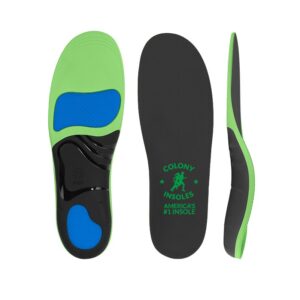 Doctor-Designed Orthotic
Premium Colony Ortho RX
- Recommended by podiatrists
- Memory foam + gel with real arch support
- 60-day money-back guarantee
- Free shipping within the USA
What rough ground asks of the foot
A serious hike is tens of thousands of foot strikes, and uneven trail loads the arch and rearfoot at angles a flat, die-cut liner simply cannot match. Strip away a structured arch and real shock attenuation, and ground reaction force routes straight up the kinetic chain, so muscular fatigue arrives well before the high point. By the turnaround you are moving on tired, unsupported feet during the most punishing phase of the outing, the descent, where eccentric loading on the quads and lateral ankle instability both peak. That combination is exactly when an unsupported foot is most likely to roll.
What we engineered for it
Colony Ortho RX is built to intercept that load before it reaches your joints. A single pair layers conforming memory foam over a responsive gel core, so each footfall is damped on contact. The structured arch shell is profiled to support the foot through the shifting angles of a climb, holding midfoot stability across loose scree and on the steep drops where ankles most often give. It mirrors the layered, supportive build clinicians favor for terrain work, and you register it from the first switchback rather than after the trip is over.
Who is logging the distance
Weekend day-hikers. Thru-hikers stacking real mileage. Hunters working broken backcountry where the footing is never level. Anyone who wants to stand, walk, and climb with the foot properly supported no matter how rough the route turns.
- Memory foam over gel that damps trail impact strike after strike
- A structured arch shell that cuts fatigue and stabilizes the midfoot on uneven ground
- A snug, secure fit for most hiking boots and trail runners
- Rearfoot and arch support built to extend your range with less heel and arch strain
- One pair, $29, with free shipping nationwide
If trail running is closer to your pace, the cushioning carries over cleanly, and our guidance on insoles for running covers it. Because boot fit governs how the foot is held across a long day, the notes on boot inserts help you set up before the next trip, and dropping arches are worth reading about in insoles for flat feet.
Switching insoles can feel like a wager, so we removed the wager. Every pair is backed by a 60-day money-back guarantee: take them through muddy creek crossings and rocky ridgelines, and if they do not change how your feet hold up out there, send them back for a full refund.
Your next hike deserves to be remembered for the summit, not the ache on the way down. Get your Colony Ortho RX and let the foot work the way it should.
Related Insoles & Guides
- Insoles for Ski Boots: Warmer & Stable
- Insoles for Cowboy Boots
- Insoles for Work Boots
- Insoles for Red Wing Boots
Frequently Asked Questions
Why do my heels and arches hurt most on the way down?
Descent is the heaviest phase of a hike. Braking steps drive sharper heel impact, eccentric loading on the quads peaks, and by the turnaround your feet are already fatigued — so the arch has less muscular help exactly when ground reaction force spikes. A flattened factory footbed offers nothing at that point; structured support and damping matter most right there.
Does a supportive insole help keep the ankle from rolling on uneven trail?
It contributes to the base of that equation. Uneven ground loads the arch and rearfoot at odd angles, and a foot pronating on a flat liner starts each step from an unstable position. A structured arch shell keeps the rearfoot seated and aligned, giving the ankle a steadier platform — though boot support, terrain choice, and leg strength still carry their share.
How does this hold up over tens of thousands of foot strikes?
The architecture is built for sustained mileage rather than showroom feel. The arch shell provides its support structurally, so it cannot pack out the way die-cut foam does, while the memory foam rides on a responsive gel core that keeps damping each footfall instead of compressing flat early in the season. A 60-day money-back guarantee backs the pair.
When should I start wearing new insoles before a long trek?
Give your feet a few shorter outings first. A corrected arch posture changes how load distributes through the foot, and tissues adapt best gradually — day hikes or daily walking before you commit to back-to-back trail miles. Pull the boot’s original footbed out, make sure the orthotic lies flat, and confirm heel fit stays snug before trusting it on a descent.