You Bought the Drugstore Pair and the Ache Came Right Back
It is a near-universal routine. The feet are throbbing, you are already mid-checkout at the pharmacy, and you yank the first insole off the pegboard. Now and then it mutes the pain for a few days. Far more often it crushes flat almost immediately and the soreness rolls back in. That failure is physics, not misfortune, and it pays to grasp the reason before you reach for an identical box.
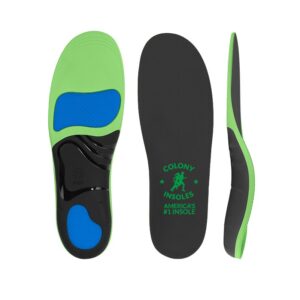 Doctor-Designed Orthotic
Premium Colony Ortho RX
- Recommended by podiatrists
- Memory foam + gel with real arch support
- 60-day money-back guarantee
- Free shipping within the USA
The Reason Pegboard Pads Quit
A pharmacy aisle is curated for breadth of choice, not for governing how a foot moves. Most of what dangles there is a slab of soft foam with no rigid arch element underneath it. Bare foam offers a fleeting hug, but it cannot resist pronation, cannot hold the medial arch from sinking, and surrenders to repeated load until it stops attenuating anything. Strip out the structure and the exact loading fault that lit up your pain is back in business, so you grab a replacement, and the receipts quietly pile up while the underlying mechanics sit untouched. A device that surrenders its shape cannot keep correcting your gait.
Where the Colony Orthotic Parts Ways
We engineer one insole, held to a clinical bar. It marries durable memory foam and gel with a structured, geometric arch shell built to keep its contour rather than fold, alongside true shock attenuation for unforgiving floors. That shell fights the inward roll of pronation and braces the arch right through the gait cycle. It is podiatrist-designed, it arrives at your door, and at $29 a pair it is straight mechanical value instead of a wall of gambles.
- A load-bearing shell built to keep its geometry, not flatten inside a week
- Geometric arch support that opposes overpronation rather than a featureless pad
- Memory foam and gel that conform to your feet while damping impact
- Support that helps you stand, walk, and run with load properly governed
- Podiatrist-designed, medical-grade build shipped to your door
Who This Suits
Anyone sick of replacing throwaway pads who wants a device that keeps doing its job. If you grabbed those rack inserts for one nagging complaint, odds are we have a page tackling its mechanics head-on, such as our inserts for metatarsalgia or our guide to heel pain.
Walk past the pegboard and buy a device engineered for the work. Order today with free shipping anywhere in the USA and a risk-free 60-day money-back guarantee. Order a pair of Colony Ortho RX and quit paying twice for the same disappointment. This is general education, not a diagnosis of your condition.
Related Insoles & Guides
- Best Shoe Inserts for All-Day Comfort
- Heel Inserts for Heel Pain Relief
- Gel Insoles for Real Shock Absorption
- Height-Boosting Shoe Inserts
- Orthopedic Shoe Inserts
- Arch Support Shoe Inserts
Frequently Asked Questions
Why did my drugstore insole flatten out and stop helping within weeks?
Most pegboard insoles are a single slab of soft foam with no rigid arch element underneath. Foam compresses under repeated body-weight loading and, once crushed, stops attenuating anything. Without structure that resists deformation, the pad cannot keep resisting pronation or holding the medial arch, so the original loading fault, and the pain it produced, comes right back.
What does Colony build into its insole that a pharmacy foam pad lacks?
The decisive difference is a structured, geometric arch shell engineered to keep its contour under load. Cushioning still matters, so durable memory foam and gel handle shock attenuation, but the shell is what resists pronation and stops the medial arch from sinking, corrective work that bare foam physically cannot perform.
Does rebuying cheap pairs really cost more than one structured orthotic?
Often, yes. Soft pads that crush flat get repurchased every time the soreness rolls back in, and the receipts stack up while the underlying mechanics stay untouched. A $29 orthotic that holds its geometry keeps working on the loading fault instead of briefly masking it, and Colony backs the switch with free US shipping and a 60-day money-back guarantee.
Can a more structured insole still feel comfortable if I'm used to soft foam?
Yes, though the sensation differs. Bare foam feels plush immediately and quits quickly; a supported arch can feel firm at first while your feet adjust to loading correctly. Memory foam and gel keep ground contact cushioned, but the shell underneath is doing the real work. Many wearers acclimate over the first several days of normal use.