It registers like a marble wedged beneath the ball of your foot, or a bunched-up sock seam you cannot smooth out. You pause, slip the shoe off, and look. Nothing is there. That ghost lump, usually trailing a burning or shock-like zing between the third and fourth toes, is the signature of Morton’s neuroma, and it can make a quick errand feel like a thing to dread.
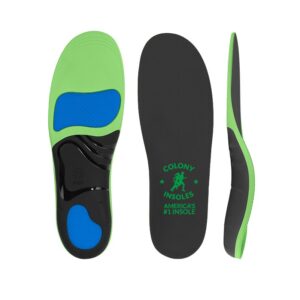 Doctor-Designed Orthotic
Premium Colony Ortho RX
- Recommended by podiatrists
- Memory foam + gel with real arch support
- 60-day money-back guarantee
- Free shipping within the USA
What Is Going Wrong at the Nerve
Morton’s neuroma is a nerve complaint with a mechanical engine. The sheath around one of the interdigital nerves running between the metatarsal heads thickens and turns irritable, and with each step the bones above pinch down on that swollen nerve. A cramped toe box drives the metatarsals together. A forefoot with nothing supporting it lets full body weight settle right onto the aggravated segment. Pinched and loaded, the nerve fires.
How the Orthotic Unloads the Forefoot
Colony Ortho RX is built around one clinical idea: the metatarsal zone needs to be offloaded, never ramped up against a hard edge. Memory foam wraps the forefoot while a gel layer beneath soaks up ground reaction force, so each step arrives softened rather than stabbing. Just as critical, the arch carries genuine geometric structure, lifting the midfoot and shifting load across the whole foot. That is the piece people overlook: relieve the irritated interspace and the nerve finally gets room to quiet down.
Who Tends to Develop It
Nurses circling a ward, teachers planted on classroom tile, runners stacking weekly mileage, anyone whose dress shoes pinch the toes. Whenever work or footwear crowds the forefoot, the interdigital nerves end up bearing the load.
- Memory foam and gel working together to pad the metatarsal heads where the neuroma sits
- Structured arch support that diverts pressure away from the irritated nerve
- Genuine shock attenuation to settle the repeated impact that keeps it inflamed
- A podiatrist-designed, medical-grade build that holds up to standing, walking, and running
- A slim profile that fits sneakers, work shoes, and dress shoes without crowding the toes
Because every foot loads differently, it pays to read around. If your discomfort centers more on the heel and arch, see our guide to insoles for plantar fasciitis. If your arches sit tall and rigid, our shoe inserts for high arches will help you fine-tune the fit, and our arch support inserts round out everyday coverage.
No one should be planning a day around where it stings to walk. Memory foam, gel, and a truly supportive arch hand that nerve the room it needs to calm. We keep the choice low-stakes: free shipping anywhere in the USA and a risk-free 60-day money-back guarantee. If they do not help, ship them back, no debate.
One orthotic insole, made properly, $29 a pair. Give your forefoot the offloading it has been asking for.
Related Insoles & Guides
- Insoles for Sciatica: Support & Relief
- Insoles for Shin Splints Relief
- Insoles for Bunions: Cushioned Relief
- Shoe Inserts for Foot Pain Relief
- Plantar Fasciitis Explained: Causes & Relief
- Running Insoles for Arch & Heel Relief
Frequently Asked Questions
Why would arch support help pain that sits under the ball of my foot?
Because load is a budget. When the midfoot has no structure, body weight settles directly onto the metatarsal heads — exactly where the irritated nerve sits. The insole’s contoured arch lifts the midfoot and redistributes that load across the whole plantar surface, so each step delivers less compression to the interdigital nerve between the third and fourth toes.
Does the insole put a hard pad under the sore spot?
No. The design philosophy here is offloading, not pressing back. A memory foam layer cradles the forefoot while the gel base beneath absorbs ground reaction force, so the metatarsal zone meets cushioning rather than a rigid edge. Pressure is moved away from the inflamed nerve segment instead of concentrated against it.
Can an insole actually shrink the thickened nerve?
An insole changes mechanics, not tissue. The thickened sheath formed because the nerve was repeatedly pinched and loaded; reducing metatarsal compression and softening each footstrike removes much of that ongoing irritation, which gives symptoms room to settle. If burning or electric pain persists despite better mechanics and roomier footwear, have a podiatrist evaluate the foot directly.
What should I change about my shoes while using these for neuroma pain?
Prioritize toe box width. A cramped forefoot squeezes the metatarsal heads together and pinches the nerve from the sides — something no insole can counteract from below. Trim the insole to your size, fit it into shoes that let the toes splay, and the two changes work together: less side-to-side compression, less vertical load on the nerve.