What an under-pronated, outward-rolling foot looks like
Supination, or under-pronation, describes a foot that fails to roll inward enough through the gait cycle and instead loads its lateral border. The clearest evidence is wear pattern: a shoe whose outer heel and outsole are ground down while the medial side stays intact points to weight tracking along the outside edge. People often report a sense of lateral ankle instability stepping off a curb, or an ache running along the fifth-metatarsal side of the foot. When body weight stays on that outer column, the medial structures built to share load through midstance never engage, and force concentrates where the foot is least equipped to disperse it.
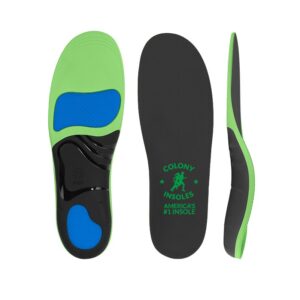 Doctor-Designed Orthotic
Premium Colony Ortho RX
- Recommended by podiatrists
- Memory foam + gel with real arch support
- 60-day money-back guarantee
- Free shipping within the USA
Why rearfoot alignment matters up the kinetic chain
The foot sets the foundational angle for the joints stacked above it. A rigid, supinated foot is a poor shock absorber, so impact that should be dissipated at the subtalar joint is instead transmitted upward. Lateral ankle sprains become more likely, patellar tracking can be disturbed at the knee, and the hips and lumbar spine compensate for the altered ground contact. This is why a forefoot or rearfoot mechanical fault sometimes presents as knee or low-back symptoms far from the foot itself. Guiding the rearfoot toward a more neutral, balanced strike gives that chain a stable base to work from.
How the orthotic guides the foot toward neutral
Colony Ortho RX is built around a structured, geometric arch that supports the medial longitudinal arch and encourages the foot to track toward center rather than continuing to roll laterally. Cushioning is concentrated along the outer border, where supinators contact hardest, using layered memory foam and gel for the shock attenuation a rigid foot type tends to lack. This is podiatrist-designed, medical-grade orthotic support doing genuine biomechanical work, without the cost and lead time of a casted custom device.
- Structured arch support that encourages a more neutral rearfoot position through midstance
- Lateral cushioning placed where the supinated foot loads most heavily
- Memory foam and gel that attenuate shock before it reaches the ankle and knee
- A stable footbed that reduces lateral wobble and improves standing balance
- Free USA shipping and one fair price of $29 a pair
Who this orthotic is built for
High-arched, rigid foot types, runners and walkers wearing through the outer sole, and anyone whose lateral ankle feels one misstep from rolling will benefit from controlled medial guidance. Because supination feeds the whole chain, it is worth reading how the same support eases lower back pain. For a more responsive, energetic feel underfoot once you are tracking neutral, see what we mean by insoles with spring.
A foot that tips you onto its outer edge with every step does not have to dictate your stability. Try Colony Ortho RX risk-free for 60 days — if your gait does not feel steadier, return them for a full refund. Order your pair today and put your stride back on balanced ground.
Related Insoles & Guides
- Insoles to Correct Supination (Outer Foot)
- Shoe Inserts to Correct Supination
- Insoles for Supination (Underpronation)
- Best Insoles for Nike Shoes
- Orthopedic Insoles
- Powerstep Alternative
Frequently Asked Questions
How can I tell whether I actually supinate?
Check your most-worn shoes. A heel and outsole ground down along the outer edge while the inner side stays intact indicates weight tracking along the lateral border — the hallmark of under-pronation. Other common signals include a feeling of ankle instability stepping off curbs and an ache along the fifth-metatarsal side of the foot. A gait assessment can confirm what the wear pattern suggests.
Why does a supinated foot cause trouble at the knee or lower back?
A foot that stays rolled outward is rigid through midstance, so the subtalar joint never performs its shock-absorbing inward motion. Impact that should dissipate at the foot is transmitted up the chain instead, where it can disturb patellar tracking and force the hips and lumbar spine to compensate for altered ground contact. That is why a rearfoot fault sometimes surfaces as knee or back symptoms first.
Can an insole actually change the way my foot rolls outward?
An insole cannot rebuild your gait, but it can change the platform your foot lands on. A supportive heel cradle and structured arch guide the rearfoot toward a more neutral, balanced position, encouraging the medial structures that should share load through midstance to engage. Weight then disperses across the whole foot instead of concentrating along the outer edge, where the foot is least equipped to disperse it.
Will these help the lateral ankle instability I feel stepping off curbs?
When weight rides the outer column, the ankle sits nearer the position from which lateral sprains occur, which is why supinators often describe that wobble stepping off curbs. Cradling the heel and guiding the rearfoot toward neutral reduces the outward bias underfoot. An insole is not a substitute for ankle strengthening, though, and recurrent sprains or giving-way episodes warrant professional evaluation.