The day the factory footbed gives out
Plenty of trail shoes arrive with a stock OrthoLite liner that performs acceptably across a few outings, then quietly crushes flat. Once it bottoms out, the slim structure it once lent vanishes, and your feet begin protesting on the long downhills. A die-cut sheet of foam shipped inside the box is engineered to cushion, not to hold the foot aligned over punishing distance. Swapping it costs less than one mid-route resupply, yet it reshapes the way a foot is carried once the miles accumulate.
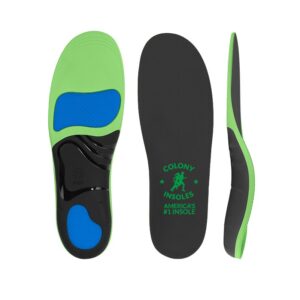 Doctor-Designed Orthotic
Premium Colony Ortho RX
- Recommended by podiatrists
- Memory foam + gel with real arch support
- 60-day money-back guarantee
- Free shipping within the USA
Why this upgrade is fundamentally mechanical
Plush, low-profile stock insoles feel luxurious on the first hike yet supply almost no scaffolding. Stretch that across hours over broken ground and the arch finds nothing to press against, the intrinsic muscles tire, stride economy slips, and soreness migrates north toward the knees and hips. Genuine arch support holds the foot stacked so the kinetic chain fires as designed, repetition after repetition. Just as critical, a structured device retains its form under sustained load rather than caving the instant a slim foam layer gives way.
How the orthotic stacks up
Colony Ortho RX is the more thoughtfully engineered replacement. Trading bare foam for layered construction, it marries memory foam and gel for cushioning that endures with a geometrically structured arch that keeps its shape under repeated pressure. You get true shock attenuation on jarring landings and a footbed positioned as podiatrist-designed, medical-grade support, the whole thing $29 a pair. One deliberate build, no sprawling catalog to decode, no gimmicks. Hikers who flattened a stock liner tell us the support lasts the full route at last.
- Firmer, longer-living arch support than a packed-out foam liner
- Memory foam and gel cushioning made for full-day distance
- Shock attenuation over jagged descents and unforgiving pavement alike
- Structure tuned to trim late-mile fatigue across walking, hiking, and running
- One straight price, $29, with nothing tacked on at checkout
Who benefits from the swap
Trail runners, weekend hikers, and anybody whose fresh footwear never felt structurally sound out of the box make prime candidates for a built-up replacement. When hard ground hammers the feet, look at the way we manage impact across our cycling shoe insoles, and runners chasing rearfoot stability tend to begin with our heel support insoles. Those who feel the strain travel upward can also read our insoles for lower back pain.
A spent factory footbed should not cut your routes short. Move up to a $29 pair of Colony Ortho RX, with free shipping across the USA and a 60-day money-back guarantee that lets you put them through their paces on home terrain with nothing at stake. Order your pair and restore the structure your shoes left out.
Related Insoles & Guides
- Powerstep Alternative
- Superfeet Insole Alternative
- Xstance Insole Alternative
- Aetrex Alternative Insoles
- Custom Insoles Alternative for $29
- Birkenstock Alternative Insoles
Frequently Asked Questions
Do I need to modify my Salomon shoes to fit this replacement insole?
No shoe modification is needed. Lift out the factory OrthoLite liner, lay it over the Colony Ortho RX as a tracing template, and cut the orthotic to match its outline — it is designed to be trimmed to fit. The trimmed insole then drops into the same footbed cavity the die-cut sheet occupied, replacing flat foam with structured support.
Why do my feet ache on long downhills even though the stock liner feels soft?
Softness and support are different jobs. A plush die-cut liner cushions early steps but gives the arch nothing to press against, so on sustained descents the intrinsic foot muscles absorb the braking load themselves and tire. That fatigue is what registers as ache, and it can migrate toward the knees and hips. A structured arch keeps the foot stacked so the kinetic chain shares the work.
How does this hold up over sustained trail mileage compared to the foam it replaces?
A die-cut foam sheet works by compressing, and under repeated load it eventually stays compressed — the flattening you notice once it bottoms out. Colony Ortho RX separates the two jobs: a geometrically structured arch carries alignment, so the memory foam and gel layers are not asked to double as scaffolding. The structural component is designed to hold its form under sustained mileage rather than caving.
Can one pair move between my trail runners and hiking boots?
Once trimmed, the insole can move between shoes with a similar interior length and width, so one pair can rotate between trail runners and boots. Trim conservatively to the larger footbed first and test before cutting further — removed material cannot be restored. If your shoes differ substantially in shape or volume, dedicated pairs avoid compromising the fit of either.