Why a Cavus Foot Concentrates Pressure
Press a high-arched foot onto a wet tile and the imprint tells the story: a heel, a forefoot, and almost no ink bridging the two. That missing band is the hallmark of a pes cavus structure, in which the medial column rides high and stays stiff instead of descending through stance. Since the midfoot never lowers to share your bodyweight, only two narrow regions carry nearly all of it. Predictably, a scorching pinpoint ache settles beneath the heel and the metatarsal heads after enough standing.
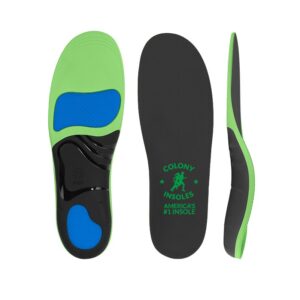 Doctor-Designed Orthotic
Premium Colony Ortho RX
- Recommended by podiatrists
- Memory foam + gel with real arch support
- 60-day money-back guarantee
- Free shipping within the USA
The Mechanics of a Stiff Midfoot
A supple foot dissipates impact by rolling inward a touch and unlocking its joints at touchdown. A cavus structure behaves in reverse. Its rigidity keeps the arch clamped shut, so ground reaction force travels upward with very little internal cushioning. Clinicians label this foot a weak natural absorber, which accounts for the punishing heel-and-ball loading it shows. Until something rises to occupy the empty midfoot, peak plantar pressure remains crammed onto a tiny patch rather than fanned across the whole footprint.
Occupying the Empty Arch Restores Contact
The shaping on this orthotic is engineered to climb into the hollow a tall arch leaves vacant, gripping firmly along the full medial length precisely where level footbeds surrender. Once the arch is genuinely engaged, contact pressure migrates across a much wider area, draining the focal overload behind the burn. Stacked memory foam plus gel then post real shock attenuation below the rearfoot and forefoot, the exact zones a stiff structure batters hardest with each landing.
- A raised, sculpted arch support matched to high, inflexible arches rather than collapsing ones
- Wider plantar pressure spread that unloads the punishing heel and metatarsal hotspots
- Gel damping to soften impact a rigid cavus structure cannot absorb unaided
- A footbed engineered to hold its lift from your first hour deep into a ninth
- Recommended by podiatrists for structural alignment support
Who Should Reach for This Shaping
This footbed suits anyone whose arch sits tall and refuses to drop, and who is weary of liners that pancake underfoot within days. Distance runners, daily walkers, and those anchored to a standing post tend to clock the change quickest. Unsure how your structure ranks? Stack it beside our custom-feel insoles, and if rugged footwear fills your week, study the insoles for Red Wing boots or these notes on forefoot pressure relief.
Everything above explains foot structure and mechanics for learning purposes only; treat none of it as a diagnosis or individualized care. Priced at $29, every set leaves our dock with shipping covered across the United States behind a 60-day return promise. Bring home Colony Ortho RX, test the full-span lift, then return it if your feet disagree.
Related Insoles & Guides
- Comfort Insoles for All-Day Relief
- Walking Insoles for All-Day Comfort
- Women's Insoles for All-Day Comfort
- Best Shoe Inserts for All-Day Comfort
- Comfort Shoe Inserts for All-Day Relief
- High Arch Support Insoles for Pain Relief
Frequently Asked Questions
Why does a high arch hurt at the heel and ball instead of the arch itself?
Because those are the only two places a cavus foot touches down. The high, stiff medial column never descends to share body weight during stance, so the heel and metatarsal heads carry nearly all of it across two small patches. Concentrated plantar pressure there is what produces the pinpoint, burning ache after long periods of standing.
How does this insole change loading for a pes cavus foot?
The contour is engineered to rise into the hollow a tall arch leaves vacant, making firm contact along the full medial length of the foot. Once the midfoot has something to press into, body weight stops funneling exclusively through the heel and ball and fans out across a much larger share of the footprint.
Can a rigid high-arched foot absorb shock on its own?
Not well. A supple foot dissipates impact by rolling inward slightly and unlocking its joints at touchdown; a cavus foot stays rigid, so ground reaction force travels upward with little internal damping. Clinicians describe it as a weak natural shock absorber — which is why added cushioning under the heel matters for this foot type.
What is the simplest way to check whether I have a high-arched foot?
Wet your sole and step onto tile or a paper bag. A pes cavus structure leaves a heel print and a forefoot print with almost no band bridging them, because the elevated midfoot never touches down. Treat it as a rough screen rather than a diagnosis — a podiatrist can confirm your foot type.