The hidden biomechanics under a formal shoe
Dress leather is engineered around the eye, not the foot. Designers chase a low-profile last and a clean toe spring, which leaves the inner surface essentially planar. That planar shape ignores the way a healthy foot actually contacts the ground: through three arches that need to be matched, not flattened. Wear a rigid pair from morning meetings to an evening dinner and the structural deficit compounds with every stride.
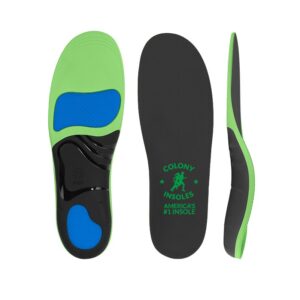 Doctor-Designed Orthotic
Premium Colony Ortho RX
- Recommended by podiatrists
- Memory foam + gel with real arch support
- 60-day money-back guarantee
- Free shipping within the USA
Where the load goes when the footbed gives nothing back
On a flat, unsupported board, the medial longitudinal arch has no scaffold beneath it, so it drops further into stance than it should. As the arch elongates, the plantar fascia is stretched along its full length and the windlass mechanism that should stiffen the foot at toe-off works against tension it was not designed to hold. Simultaneously, body weight funnels onto the metatarsal heads and the heel meets a thin, unforgiving sole with little to dissipate the impact. The shine stays flawless; the kinetic chain pays the bill.
How an orthotic footbed corrects the deficit
Slide a structured insert into the same shoe and the mechanics shift. The contoured arch support fills the void under the midfoot, limiting how far the arch collapses and easing the pull on the fascia. The memory foam and gel layering introduces the shock attenuation a leather board never offered, spreading heel-strike and forefoot pressure across a wider area. Because the geometry is kept low, it nests into formal footwear without lifting the heel out of the counter or crowding the toes.
- Restores arch contour to a flat, rigid dress-shoe board
- Limits medial arch collapse that overloads the plantar fascia
- Offloads pressure from the metatarsal heads during long wear
- Adds gel-based shock attenuation on marble, tile, and pavement
- Low-profile construction built to a podiatrist-recommended standard
Who benefits most
Clinicians, attorneys, hospitality staff, and anyone whose formal footwear doubles as all-day standing gear will feel the difference in foot fatigue. If your rotation includes other demanding styles, our guidance on insoles for high heels covers a related loading challenge, and readers fighting forefoot pressure may want our notes on the z-liner-style fit.
A sharp pair and a well-aligned foot are not mutually exclusive. Give your leather shoes discreet, medical-grade orthotic structure. Order Colony Ortho RX insoles for your dress shoes.
Related Insoles & Guides
- High Arch Insoles for All-Day Comfort
- Comfort Insoles for All-Day Relief
- Easy Feet Comfort Insoles
- Walking Insoles for All-Day Comfort
- Women's Insoles for All-Day Comfort
- Insoles for Seniors: Comfort & Stability
Frequently Asked Questions
Why do my feet ache after a full day in leather dress shoes?
Dress lasts are built for a clean silhouette, so the footbed inside is essentially flat. With nothing under the medial longitudinal arch, the arch elongates through every stance phase, the plantar fascia takes the strain, and load funnels onto the heel and metatarsal heads over a thin, stiff sole. The ache is accumulated mechanical overload, not simply tired feet.
Can a structured insole fit inside a slim oxford without crowding my foot?
Yes, with trimming. The insole is trim-to-fit: cut the forefoot edge so the outline matches the shoe. If the factory liner lifts out, removing it frees most of the volume the orthotic needs, so the contoured arch sits under your midfoot without lifting your heel out of a low-profile counter.
What does the windlass mechanism have to do with dress shoe inserts?
At toe-off, your big toe dorsiflexes and winds the plantar fascia tight, stiffening the foot into a rigid lever. On a flat dress footbed the arch has already elongated under load, so the windlass mechanism works against extra tension. Supporting the arch limits that elongation, letting the foot stiffen for push-off without overworking the fascia.
Does the insert address heel impact on hard floors, or only the arch?
Both regions are addressed. The gel base under the heel attenuates the strike that a thin leather sole passes straight through, while the geometric arch support carries midfoot load so weight stops funneling onto the heel and metatarsal heads. Offloading and cushioning work together; neither alone corrects a flat dress footbed.