Pull out the liner and you’ll see the problem
Lift the insert out of nearly any new shoe and you’re holding a thin, flat sheet of foam that packs down to almost nothing within weeks. No meaningful cushioning, no contour, no structural support. I’m Jack Young, founder of Colony Ortho RX, and I built our orthotic because that hard, unsupportive footbed leaves feet fatigued before the afternoon is over, with nothing controlling how load is distributed across the foot.
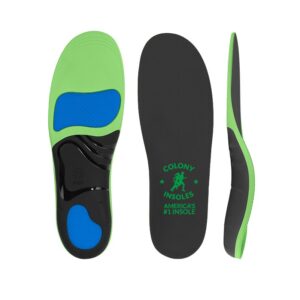 Doctor-Designed Orthotic
Premium Colony Ortho RX
- Recommended by podiatrists
- Memory foam + gel with real arch support
- 60-day money-back guarantee
- Free shipping within the USA
What memory foam actually does mechanically
Memory foam responds to the foot. Under body heat and load it conforms to the plantar surface, then distributes pressure across the full footbed instead of concentrating it at the heel and the metatarsal heads. That redistribution means fewer high-pressure zones, less localized fatigue, and a cushioned feel that holds rather than bottoming out by week three. Placed over the right structure, standing and walking quietly stop demanding your attention.
How we build a foam that supports rather than collapses
Soft on its own isn’t the goal, because unsupported foam simply compresses flat. We pair a responsive memory foam top layer with a gel base for shock attenuation, then anchor the whole assembly on structured, geometric arch support so you get conforming cushioning and biomechanical stability together. That balance, a supportive shell under a forgiving surface, is what makes the difference between an insole that feels nice in the store and an orthotic that carries you through a twelve-hour shift. One medical-grade orthotic, $29 a pair, no upsells.
- Conforms to the plantar surface for a genuinely individualized fit
- Distributes pressure to relieve the heel and forefoot load zones
- A gel layer that attenuates impact at every heel strike
- A structured arch that keeps the foam supportive rather than mushy
- Holds its cushioning far longer than a factory liner
If your shoes run a touch large, this same orthotic helps you make big shoes fit securely, and anyone who needs more midfoot contact can pair the concept with our high arch support guidance.
Who this suits
If you’re on your feet all day, walk for exercise, or want everyday shoes to manage load better, this is for you. Nurses, retail workers, travelers, and weekend walkers describe the same outcome in different words: their feet stop complaining by the end of the day.
Give your feet cushioning built on real structure. Every pair includes free U.S. shipping and a 60-day money-back guarantee. Order your pair today and feel the difference the moment you step in.
Related Insoles & Guides
- Memory Foam Insoles
- Comfortable, Durable EVA Foam Insoles
- Best Shoe Inserts for All-Day Comfort
- Heel Inserts for Heel Pain Relief
- Gel Insoles for Real Shock Absorption
- Height-Boosting Shoe Inserts
Frequently Asked Questions
Does memory foam flatten out the way factory shoe liners do?
Stock liners are thin, flat sheets of foam that pack down within weeks because nothing beneath them carries load. Here the memory foam is a top layer riding on a gel base and a structured arch, so the foam’s job is conforming to the plantar surface, not bearing your full weight alone, which is what drives rapid pack-down.
How does memory foam actually move pressure around underfoot?
Under body heat and load, the foam conforms to your plantar surface, increasing contact area across the entire footbed. More contact area means the same body weight is divided over more square inches, so pressure stops concentrating at the heel and metatarsal heads. Fewer high-pressure zones translates to less localized fatigue through a long day of standing.
Why anchor the foam on a geometric arch instead of selling soft foam alone?
Because unsupported softness simply compresses flat and controls nothing. The structured arch maintains the foot’s alignment and decides how load is distributed; the gel base attenuates impact at heel strike; the memory foam handles surface conformity. Remove the structure and you lose the biomechanical correction, keeping only cushioning that collapses under sustained weight.
What does the gel base add that memory foam cannot do on its own?
Shock attenuation. Memory foam excels at conforming and spreading static pressure, but it is not built to absorb the sharp impact spike of heel strike, especially on hard flooring. The gel layer dissipates that transient force before it travels up the leg, while the foam above keeps managing contact pressure across the footbed.