Six Across, but the Real Answer Lives Inside Your Shoe
Land on this page chasing a grid clue for “shoe inserts”? Pencil it in, you found the square. Still, that neat little fill-in points at something with genuine mechanical weight: a device that rewrites how your feet cope with a day spent pounding hard surfaces. Since the puzzle dragged you over, allow a brief tangent into what an honest orthotic insert performs under load, because the answer in the grid undersells the answer under your arch.
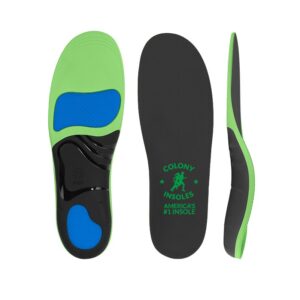 Doctor-Designed Orthotic
Premium Colony Ortho RX
- Recommended by podiatrists
- Memory foam + gel with real arch support
- 60-day money-back guarantee
- Free shipping within the USA
What That Slab Beneath Your Sole Actually Does
An insert, or insole, bridges the underside of your foot and the floor of the shoe. The flimsy sheet the factory tucks in mostly fills volume; structurally it contributes almost nothing. A deliberately engineered orthotic does four jobs at once: it occupies the hollow under the arch, it dampens the force peaks at landing and lift-off, it holds the medial longitudinal arch from caving, and it spreads plantar pressure so no single patch shoulders the entire body weight. For anyone vertical for hours, that spreading decides whether feet survive the shift or quit by noon. Many people file sore feet under aging or hard labor. Frequently the culprit is footwear that mismanages load, a correction far cheaper than the years people blame.
How Ours Was Drawn Up
We produce a single insole, engineered to a clinical specification. Memory foam and gel deliver the cushioning and shock attenuation, a structured, geometric arch shell braces the foot and pushes back against pronation, and the assembly holds its impact control stride after stride on concrete. It is podiatrist-designed and sells for $29 a pair, no across-or-down required to crack the value.
- Memory foam and gel cushioning that attenuates shock through a marathon shift
- Geometric arch shell that keeps the foot aligned and counters overpronation
- Impact control engineered for warehouse floors and back-to-back shifts
- Molds to the contours of your foot across the opening wears
- Podiatrist-designed support for standing, walking, and running
Who Tends to Land Here
Puzzle solvers, naturally, but truly anyone whose feet are begging for structural reinforcement. If the clue brought you and the mechanics kept you, our arch support inserts page and our breakdown of inserts for metatarsalgia lay out the loading story without jargon.
You finished the clue. Foot pain is the next entry down. Buy today with free USA shipping and a risk-free 60-day money-back guarantee. Pick up a pair of Colony Ortho RX. This is educational, not personal medical advice, so consult a clinician about any foot pain that lingers.
Related Insoles & Guides
- Gel Insoles for Real Shock Absorption
- Magnetic Shoe Inserts vs. Real Support
- Z-Liner Insoles: Slim Fit + Real Support
- Best Shoe Inserts for All-Day Comfort
- Heel Inserts for Heel Pain Relief
- Height-Boosting Shoe Inserts
Frequently Asked Questions
What separates a real orthotic insert from the flat liner that came in my shoe?
The factory liner mostly fills volume inside the shoe and adds almost no structure. A purpose-built orthotic performs four jobs at once: it occupies the hollow under your arch, dampens force peaks at landing and push-off, holds the medial longitudinal arch from caving, and spreads plantar pressure so no single patch of foot carries your full body weight.
Why do my feet quit by early afternoon when I work on hard floors?
Hard surfaces return impact instead of absorbing it, and hours of standing concentrate load on a few small zones, typically the heel and the ball. Pressure that should spread across the whole plantar surface piles onto those patches until they protest. Many people file that under aging or hard labor when it is often footwear mismanaging load, which is correctable.
How does Colony's orthotic manage all four of those jobs in one device?
A structured, geometric arch shell occupies the space under the medial arch and resists collapse through repeated loading, while memory foam and gel layers damp the force spikes at heel strike and push-off. Together they redistribute plantar pressure across a wider area, and the insole trims to fit your shoe so the support sits where your anatomy actually loads.
Is it reasonable to try an orthotic when a puzzle, not a podiatrist, sent me here?
It’s a low-stakes experiment. Colony’s insole is a non-prescription, podiatrist-designed device at $29 with free US shipping and a 60-day money-back window. This page is general education, though: foot pain that is severe, worsening, or tied to a diagnosed condition deserves an in-person clinical evaluation rather than a self-selected insert alone.