Where the sacroiliac joint sits in the kinetic chain
The sacroiliac joint is the junction where the sacrum meets the ilium of the pelvis. It moves very little by design, transferring load between the spine and the legs. When it becomes a source of pain, you tend to feel it deep and low on one side, often sharpest during the transition from sitting to standing, the first steps of a walk, or climbing stairs. What gets overlooked is that this joint sits at the top of a closed kinetic chain that originates at the foot. Ground contact begins there, and the way the foot accepts load sets the tone for everything above it.
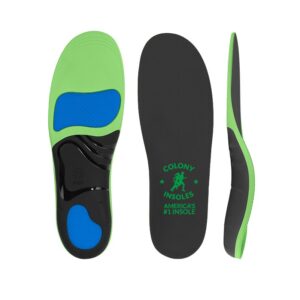 Doctor-Designed Orthotic
Premium Colony Ortho RX
- Recommended by podiatrists
- Memory foam + gel with real arch support
- 60-day money-back guarantee
- Free shipping within the USA
How foot mechanics load the pelvis
Consider the chain from the ground up. When an arch lacks adequate support and collapses, the rearfoot rolls into excessive pronation. That inward roll drives internal rotation at the tibia and femur, and the pelvis rotates to accommodate. Repeat that pattern thousands of times a day on hard flooring in unsupportive shoes, and the sacroiliac joint absorbs rotational and shear forces it was not built to manage. Controlling pronation at the foot is one of the more direct ways to reduce the rotational demand traveling up to the pelvis.
How Colony Ortho RX builds a corrective foundation
Our orthotic uses a structured arch profile engineered to hold its geometry under body weight, so the rearfoot stays aligned rather than collapsing and feeding rotation up the chain. Beneath that, layered gel and memory foam attenuate impact at heel strike before it propagates toward the pelvis and lumbar spine. An honest note: this is not a treatment or a cure for a sacroiliac joint disorder, and we will not frame it as one. It is designed to reduce mechanical load on the chain that feeds into the joint. This is podiatrist-designed, medical-grade support, one pair, $29.
- Structured arch support that limits pronation and the rotation it sends up the chain
- Gel shock attenuation that blunts heel-strike impact before it reaches the pelvis
- Rearfoot stabilization to keep the kinetic chain aligned through stance
- Memory foam cushioning that distributes plantar pressure across a full day
- Podiatrist-designed orthotic construction with free shipping across the USA
Who tends to benefit
If standing and walking are the activities that provoke your lower back or hip, the foot is a sensible, low-risk place to start addressing the mechanics. Alignment problems rarely stay isolated, so if symptoms also appear toward the forefoot, our discussion of big toe joint pain may be relevant. And because alignment begins with a rearfoot that stays seated, our heel cups guidance pairs naturally with this one.
When the base is stable and impact is managed low in the chain, the structures above have less to compensate for. Place a pair in your shoes and assess how a corrected foundation feels over a full day. Try Colony Ortho RX for 60 days, risk-free. Order a pair and start supporting your back from the ground up.
Related Insoles & Guides
- Insoles for Big Toe Joint Pain
- Heel Inserts for Heel Pain Relief
- Shoe Inserts for Ball of Foot Pain
- Shoe Inserts for Back Pain
- Insoles for Ball of Foot Pain
- Shoe Inserts for Knee Pain
Frequently Asked Questions
How can something under my foot influence pain at my pelvis?
Through the closed kinetic chain. Ground contact starts at the foot, and the way the foot accepts load sets the rotational behavior of everything above it, tibia, femur, and pelvis included. The sacroiliac joint sits at the top of that chain, transferring force between spine and legs, so foot mechanics are part of its daily workload.
What does overpronation actually do to the sacroiliac joint?
When an unsupported arch collapses, the rearfoot rolls inward, driving internal rotation up the tibia and femur. The pelvis rotates to accommodate, and the SI joint, designed for minimal motion, absorbs rotational and shear forces it was not built to manage. Repeated thousands of times daily on hard floors, that pattern becomes a persistent mechanical stressor.
Does one-sided SI pain mean my feet load differently from each other?
It can, though not always. Sacroiliac pain typically presents deep and low on one side, and asymmetries in pronation or limb mechanics are among the possible contributors. Supporting both arches evens the rotational demand traveling up each leg, but persistent one-sided pelvic pain warrants evaluation by a clinician who can examine your full chain in person.
When are insoles a reasonable part of managing SI joint pain, and when are they not?
They are reasonable as one input among several when excessive pronation is feeding rotational stress into the pelvis, particularly if you stand or walk long hours on hard flooring. They are not a treatment for the joint itself, and pain that is severe, worsening, or unexplained should be assessed medically before you rely on any footwear change.