The Tell-Tale Sign Your Feet Roll Outward
Turn a pair of your shoes over and read the outsoles. If the lateral edges are worn down while the medial side still looks new, the foot is supinating, rolling weight onto the outer border through each step rather than distributing it across the whole foot. Underpronation is the clinical term. It looks minor on an outsole, but that lateral weight bias quietly loads the ankle, tibia, and knee with stress they were not designed to carry alone. The wear pattern is your first diagnostic clue.
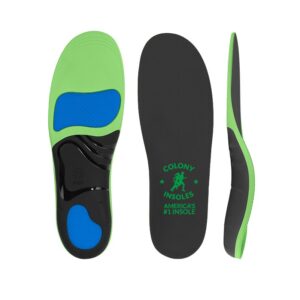 Doctor-Designed Orthotic
Premium Colony Ortho RX
- Recommended by podiatrists
- Memory foam + gel with real arch support
- 60-day money-back guarantee
- Free shipping within the USA
Why a Small Roll Causes Outsized Trouble
A supinating foot does not absorb impact the way a neutral foot does. Force that should fan across the entire plantar surface gets funneled into a narrow lateral strip instead. Repeat that loading thousands of times a day and the result is lateral ankle strain, tibial soreness after running, and accelerated wear at the knee. A rigid, high-arched foot also sits closer to an inversion event on a curb or trail root. The mechanical objective is to bring the foot back toward a neutral, balanced strike so the lateral border stops carrying the entire load.
How the Orthotic Steadies Your Stride
This insole is engineered to bring a high-arched, supinating foot back toward neutral alignment. The structured arch profile fills the open space under a high medial arch, giving the foot a solid surface to settle into and encouraging an even, balanced footstrike. The contoured shell redistributes weight off the lateral border and across the plantar surface. Because rigid supinating feet attenuate shock poorly, a gel layer supplies the impact absorption the foot’s own structure lacks. This is podiatrist-designed, medical-grade support.
- Structured arch support that fills and supports a high, rigid arch
- A contoured shell that encourages a balanced, more neutral strike
- Gel shock attenuation to supply what a supinating foot cannot absorb on its own
- Memory foam that redistributes load off the lateral border
- Lateral offloading that helps protect the ankle, tibia, and knee
Who This Suits
Runners, hikers, and everyday walkers with high, rigid arches who keep wearing through the outer edges of their shoes. If your ankles feel unstable laterally or your shins complain after a few miles, supination is the place to start. One clinical caveat: this is educational orthotic support, not a diagnosis, so have recurrent ankle instability assessed by a clinician.
If you are working on overall gait mechanics, our high arch insole guide is the natural next read, and those correcting alignment often pair this with our uneven leg support. Order your Colony Ortho RX today and give your stride the lateral support it is missing.
Related Insoles & Guides
- Insoles to Correct Supination & Outward Roll
- Insoles to Correct Supination (Outer Foot)
- Insoles for Supination (Underpronation)
- Best Shoe Inserts for All-Day Comfort
- Heel Inserts for Heel Pain Relief
- Gel Insoles for Real Shock Absorption
Frequently Asked Questions
How do I confirm my feet actually supinate before buying?
Flip your shoes over and compare edges. Worn-down lateral (outer) borders with a fresh-looking medial side are the classic sign of supination, also called underpronation. Pair that clue with a high, rigid arch and outer-ankle or shin soreness after walking or running, and you have a reasonably reliable picture. A clinician can confirm with a gait check.
Why would a slight outward roll bother my ankles or knees?
Because a supinating foot concentrates impact into a narrow lateral strip instead of fanning it across the whole plantar surface. Repeated thousands of times daily, that bias strains the lateral ankle, loads the tibia, and accelerates wear at the knee. A rigid, high arch also sits closer to an inversion sprain on curbs or uneven ground.
Does Colony Ortho RX address supination differently than soft cushioned inserts?
Yes. A flat foam pad only softens the misplaced load; it does not redirect it. This orthotic uses a structured arch profile that fills the space under a high arch, giving the medial column something to load against so weight spreads across the foot instead of riding the outer border through each step.
Can an insole permanently fix the way I underpronate?
No insole changes your bone structure, and we will not claim otherwise. What it can do is guide each footstrike back toward a neutral, balanced position while you wear it, easing lateral ankle and shin load. If your wear pattern and symptoms do not improve within the 60-day money-back window, return it.