By the ninth hour on a concrete warehouse floor, the small muscles in your feet have run out of capacity. The heels feel bruised, the arches have given up, and the ache has migrated into the knees and lower back. That progression is not weakness. It is a predictable biomechanical response to repetitive high-impact loading on an unyielding surface, and it is exactly what a properly engineered orthotic is designed to manage.
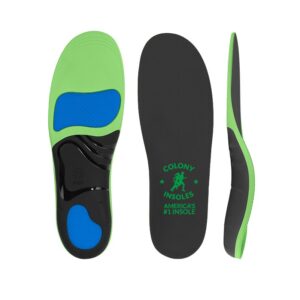 Doctor-Designed Orthotic
Premium Colony Ortho RX
- Recommended by podiatrists
- Memory foam + gel with real arch support
- 60-day money-back guarantee
- Free shipping within the USA
The Biomechanics of a Concrete Floor
Concrete returns almost none of the energy your body puts into it. Each heel strike sends a sharp ground reaction force up through the calcaneus, tibia, and knee, and over a full shift you absorb thousands of these loading cycles. As the intrinsic foot muscles fatigue, the plantar fascia and longitudinal arch take on more strain, the foot tends to overpronate, and pressure concentrates under the heel and the metatarsal heads. Stiff steel-toe boots restrict natural toe splay and add to the problem. Without shock attenuation or structural support underfoot, that mechanical stress simply accumulates.
How Colony Ortho RX Manages the Load
Colony Ortho RX is a podiatrist-designed, medical-grade orthotic built for this exact loading pattern. Responsive memory foam sits over a firm gel base to attenuate impact at the heel and forefoot before it travels up the kinetic chain. The structured arch supports the medial longitudinal arch and helps control excess pronation through the stance phase of gait, keeping the rearfoot better aligned over many hours. By redistributing plantar pressure away from the heel and metatarsal heads, the footbed reduces the focal loading that drives end-of-shift soreness. This is support engineered for pickers, packers, loaders, and forklift operators who need their feet to hold up under sustained demand.
- Layered memory foam and gel for shock attenuation against hard concrete
- A structured arch that supports the medial longitudinal arch through long shifts
- Pronation control that helps keep the rearfoot aligned during gait
- Plantar pressure redistribution that offloads the heel and metatarsal heads
- A podiatrist-designed, low-profile fit that seats inside steel-toe and standard work boots
You cannot soften the floor, but you can change the mechanics between it and your feet. If your shift is mostly static standing, read our guide on insoles for standing all day, or review our shoe inserts for work boots to match the demands of your footwear.
Try them with free USA shipping and a 60-day money-back guarantee. One orthotic insole, $29 a pair. Give your feet structured support engineered for the surface you work on, and order your Colony Ortho RX orthotic insoles today.
Related Insoles & Guides
Frequently Asked Questions
Will these orthotics fit inside steel-toe work boots?
Yes. They are trim-to-fit: pull the factory liner out of your boot, use it as a template to trim the orthotic at the toe, and reinsert. Because sizing is set at the forefoot, the arch geometry and gel heel stay untouched, which matters in stiff boots that already restrict natural toe splay.
Why does standing on concrete hurt more than walking the same hours on other surfaces?
Concrete returns almost none of the energy you put into it, so every heel strike sends an unattenuated ground reaction force up through the calcaneus, tibia, and knee. Over a full shift that is thousands of loading cycles with no recovery built in, which is why the ache accumulates instead of fading.
What happens to my arches in the last hours of a long shift?
The intrinsic foot muscles that actively hold the arch fatigue first. As they run out of capacity, the plantar fascia and longitudinal arch absorb more strain passively, the foot drifts into overpronation, and pressure concentrates under the heel and metatarsal heads. A structured arch shares that late-shift load so soft tissue is not carrying it alone.
Does foot fatigue from warehouse work explain knee and lower back ache too?
Often, yes. Impact that is not absorbed at ground contact continues up through the tibia toward the knee, and fatigue-driven overpronation adds alignment stress further up. Combining heel shock attenuation with arch and rearfoot support manages the load where it enters the body. Pain that persists despite better support deserves a clinician’s evaluation.