Type carbon fiber insoles into any search bar and you are usually chasing one feeling: a footbed that pushes back. You want something underfoot that refuses to flatten, that keeps the foot organized instead of letting it sprawl. At Colony Ortho RX we respect that engineering instinct, but the biomechanics point toward a smarter answer than a flat sheet of laminate.
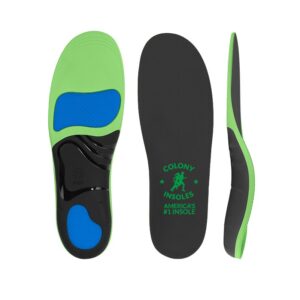 Doctor-Designed Orthotic
Premium Colony Ortho RX
- Recommended by podiatrists
- Memory foam + gel with real arch support
- 60-day money-back guarantee
- Free shipping within the USA
The Real Goal Behind the Material
Stiffness is not actually what you are buying. You are buying control of the foot’s timing. During midstance the medial longitudinal arch should depress slightly, store elastic energy, then recoil to power push-off. A footbed that mushes lets that arch over-flatten, and the arch support tissues, especially the plantar fascia, get stretched past their working range. People reach for carbon hoping to stop that collapse. Reasonable goal, blunt tool.
Why a Pure Plate Backfires
A rigid carbon shell wins the stiffness contest and loses everywhere else. Because it barely flexes, it cannot follow the foot through the rocker phases of gait, and it concentrates ground reaction force onto two unforgiving zones, the calcaneus at heel strike and the metatarsal heads at toe-off. Hours later those become the spots that ache. Rigidity without cushioning trades one problem for two.
The Three-Layer System We Chose Instead
Our build solves the same problem with a graded structure. Conforming memory foam molds to your plantar surface, a gel stratum underneath dissipates impact energy at the two high-load moments, and a firm geometric shell anchors the whole thing so the arch geometry survives mile after mile. The shell governs pronation; the upper layers handle shock attenuation. You get the steadiness carbon promises while the foot keeps moving the way anatomy intends.
- A contoured rigid base that holds its profile and guides rearfoot motion through stance
- Memory foam that captures your individual plantar contours for a near-custom interface
- Gel beneath the heel and forefoot to absorb peak loading at strike and propulsion
- A thin, flexible-where-it-counts construction that controls without locking the joints
- Trim guides so a single pair migrates between trainers, work shoes, and boots
Whether your day is spent upright at a counter, logging road miles, or just trying to make ordinary shoes stop fighting your stride, this is the support hiding behind that material search. Shoppers weighing their options frequently settle on our memory foam insoles for that responsive, molded feel, and on our arch support inserts when alignment over long hours is the priority.
You do not need a stiff plate, and you definitely do not need its usual premium. A pair runs $29, ships free across the USA, and is backed by a 60-day money-back guarantee. Get your Colony Ortho RX orthotic insoles and notice the difference exactly where load meets foot.
Frequently Asked Questions
Why does a pure carbon fiber plate often create new pain instead of fixing arch collapse?
A rigid plate cannot flex with the foot through the rocker phases of gait, so ground reaction force concentrates at the two points that still contact hard: the calcaneus at heel strike and the metatarsal heads at toe-off. The arch stops over-flattening, but those two zones absorb the load the plate refuses to spread.
Is maximum stiffness actually what my foot needs for support?
Usually not. The medial longitudinal arch is built to depress slightly at midstance, store elastic energy, and recoil into push-off. Support should limit how far the arch flattens, not eliminate that motion. A structured arch with controlled give preserves this spring mechanism while keeping the plantar fascia inside its working range.
How does Colony Ortho RX control arch collapse without a rigid shell?
Instead of one stiff laminate, the orthotic layers a firm geometric arch over cushioning materials. The arch structure resists over-flattening at midstance, while the cushioned heel and forefoot keep attenuating impact at exactly the zones a carbon plate overloads. The result is timing control through the gait cycle, not a footbed that fights it.
Can a flexible orthotic still protect the plantar fascia under heavy loading?
Yes, because fascia strain comes from how far and how fast the arch flattens, not from footbed softness alone. Bracing the medial arch keeps the fascia from being stretched past its working range, and shock-attenuating layers reduce the peak forces driving that deformation. Flexibility simply lets the foot keep its natural rocker mechanics.