The factory liner was never an orthotic
Most footwear ships with a die-cut foam liner whose job is to fill the shoe box and hold a price point. It carries no meaningful arch contour, no rearfoot control, and very little shock attenuation. Under daily loading that thin foam compresses, loses what little resilience it had, and stops returning energy. The shoe you trusted on day one starts transmitting impact straight into your heel and forefoot, because the one structural layer between your foot and the outsole has gone flat.
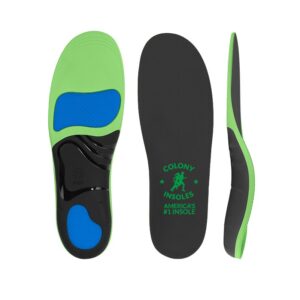 Doctor-Designed Orthotic
Premium Colony Ortho RX
- Recommended by podiatrists
- Memory foam + gel with real arch support
- 60-day money-back guarantee
- Free shipping within the USA
The interface that governs how your foot loads
The insole is the surface your foot meets on every stance phase, so its geometry largely dictates how load distributes across the plantar surface. A worn, featureless liner lets the medial arch collapse and concentrates pressure on the heel and metatarsal heads. Replacing it with a structured footbed restores the arch support and cushioning the original quietly lost, and re-establishes a stable platform for the rearfoot. You don’t need new footwear to recover that support. You need to change the part that actually does the biomechanical work, and the swap takes seconds.
Engineered as a medical-grade upgrade
Colony Ortho RX insoles are built as a direct orthotic replacement for any stock liner, sized to drop in the moment you lift the old one out. They combine conforming memory foam and shock-absorbing gel over a structured, geometric arch support that a factory insert simply does not provide. That layered construction is the kind of supportive, contact-everywhere design podiatrists favor, and it performs the same way in work boots, runners, and everyday shoes. Out with the collapsed original, in with a footbed designed for biomechanical support.
- Replaces packed-down factory liners with a structured orthotic footbed
- Memory foam and gel restore shock attenuation lost to compression
- Geometric arch support most stock inserts entirely lack
- Re-establishes a stable rearfoot platform across the gait cycle
- Distributes plantar load instead of concentrating it at heel and forefoot
When replacement is the right call
If your shoes feel harder than you remember, or you pull the liner and find it crushed and glazed, the cushioning and support have bottomed out. Replacement also suits anyone whose foot type needs more than a stock insert ever offered, such as readers of our high arch support page or those simply after better all-day comfort.
A sound pair of shoes deserves a sound footbed. Refresh the support inside the footwear you already own with podiatrist-designed orthotic insoles. Order a set of Colony Ortho RX replacement insoles.
Related Insoles & Guides
- Best Insoles for Nike Shoes
- Orthopedic Insoles
- Powerstep Alternative
- Superfeet Insole Alternative
- Xstance Insole Alternative
- Height Increase Insoles
Frequently Asked Questions
How can I tell my shoe's factory liner has gone flat?
Pull it out and look: compressed zones under the heel and ball, an outline pressed into the foam, no rebound when you squeeze it. Functionally, a shoe that feels harsher than it did new is telling you the one structural layer between foot and outsole has stopped returning energy. The midsole may be fine; the liner quits first.
Do I remove the original liner before dropping this one in?
Yes. Remove the stock liner so the orthotic sits flat on the shoe’s base and uses the volume the old foam occupied. Most factory liners lift out without adhesive. Keep it as a trimming template: lay it over the new insole, cut the forefoot edge to match, and the swap takes seconds.
What does a structured replacement change that the original foam never provided?
Three things the die-cut liner never had: a contoured arch that stops the medial arch from collapsing through stance, a stable platform that controls the rearfoot, and a memory foam and gel stack that actually attenuates impact. The factory part filled the shoe box and held a price point; the replacement does the biomechanical work.
Can one pair move between my different shoes, or do I need a pair per shoe?
Yes, it sits unglued, so lifting it out and dropping it into the next pair takes seconds, with no need to buy new footwear to move the support around. One caution: trimming is permanent. Fit it to your roomiest shoe first and remove material gradually, because an insole cut for a narrow pair cannot be sized back up.