Why a tough boot still leaves the foot unsupported
Lace up a quality work boot and you have armored the outside of your foot: a puncture-resistant plate, a reinforced toe box, and a thick midsole stand between you and the hazards underfoot. What none of that addresses is the biomechanics happening inside the boot. The original footbed is usually a wafer of low-density foam that bottoms out after a handful of shifts, leaving the plantar surface to ride directly on a rigid lasting board. Because a stiff outsole barely flexes, vertical ground-reaction forces have nowhere to dissipate and travel straight up the kinetic chain. Without an arch beneath the midfoot, the medial longitudinal arch elongates under repeated loading, the plantar fascia stretches further with every step, and rearfoot stability erodes hour by hour.
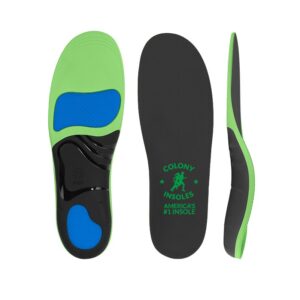 Doctor-Designed Orthotic
Premium Colony Ortho RX
- Recommended by podiatrists
- Memory foam + gel with real arch support
- 60-day money-back guarantee
- Free shipping within the USA
What an orthotic footbed changes inside a rigid boot
Lift out the thin factory liner and seat Colony Ortho RX, a podiatrist-designed, medical-grade orthotic, in its place. The structured arch support cradles the midfoot so the medial arch is held closer to a neutral position instead of flattening under body weight and a loaded tool belt. A memory foam top layer over a resilient gel base delivers genuine shock attenuation, blunting the spikes of force generated by concrete, steel grating, and rubble. That same geometry steadies the rearfoot, which curbs excess overpronation and keeps you balanced when footing turns uneven on a job site.
Built for crews who load their feet for a living
Welders, electricians, dock workers, roofers, and equipment operators all share one demand: standing and moving on unforgiving surfaces for the full clock. If you have already shredded the stock insert and feel every impact reaching your heels, this is the upgrade your boots were missing.
- Layered cushioning from memory foam over gel that resists compression across long, heavy shifts
- Engineered arch support that stabilizes the midfoot inside a stiff, protective boot
- Shock attenuation that helps spare the heels, knees, and lumbar spine from repeated ground impact
- Rearfoot control that reduces excess inward roll on uneven terrain
- Free U.S. shipping and a 60-day money-back guarantee
Support that earns its keep after hours too
Static loading is its own challenge, so if your role keeps you planted in one spot, our notes on insoles for standing all day apply directly, and anyone whose arches have dropped should review our guidance on insoles for flat feet. The swap takes seconds and the footprint matches a standard boot liner, so there is no adjustment period before they go to work. Your boots already handle protection; let an orthotic govern how the foot loads through a brutal shift. None of this substitutes for a clinician’s evaluation, and pain that lingers deserves a professional look. With two months to put them through real work, the risk is minimal. Order a pair of Colony Ortho RX and give every boot a proper biomechanical foundation.
Related Insoles & Guides
- Insoles for Ski Boots: Warmer & Stable
- Insoles for Cowboy Boots
- Hiking Insoles for Boots
- Insoles for Red Wing Boots
Frequently Asked Questions
Why do my feet still ache in a high-quality work boot?
A good boot armors the outside of the foot — puncture plate, reinforced toe, thick midsole — but does nothing for the biomechanics inside it. The factory footbed is low-density foam that bottoms out within a handful of shifts, leaving your plantar surface riding on a rigid lasting board while the stiff outsole sends ground reaction force straight up the leg.
Do I remove the boot's original footbed before installing these?
Yes — lift the factory liner out completely and seat Colony Ortho RX directly in its place. Most work-boot liners simply pull free. Using the old liner as a trimming template gets the length right, and removing it preserves toe-box depth so the structured arch sits at the correct height under your midfoot.
How does the insole cope with the extra load of a tool belt?
Added carried weight accelerates the same failure: the medial longitudinal arch elongates under repeated loading and the plantar fascia stretches further with each step. The structured arch cradles the midfoot so it holds nearer a neutral position under body weight plus gear, while the gel base absorbs the heavier force spikes that concrete returns.
What does shock attenuation add when a boot's outsole barely flexes?
A stiff outsole protects you from hazards but cannot deform to dissipate impact, so vertical ground reaction forces travel up the kinetic chain intact. Placing memory foam over a resilient gel base directly under the foot blunts those force spikes at the source — the one point in a rigid boot where compliant material can still do its work.