Why standing on a flat board punishes your feet
One comment comes up constantly: the inserts that shipped with my shoes feel like a plank. That observation is mechanically accurate. Flat foam compresses within weeks, the plastic beneath returns nothing, and after a long shift on a hard floor both the heel and the forefoot are overloaded. That isn’t a tolerance problem. Most stock inserts were never engineered to attenuate the repetitive impact your feet absorb from the moment you stand. Colony Ortho RX is built around that single mechanical task.
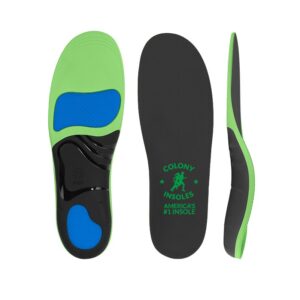 Doctor-Designed Orthotic
Premium Colony Ortho RX
- Recommended by podiatrists
- Memory foam + gel with real arch support
- 60-day money-back guarantee
- Free shipping within the USA
What gel does to ground reaction force
The foot is rarely static, and that is the point. Each step generates a ground reaction force that travels up through the calcaneus, ankle, knee, and hip. A dedicated gel layer disperses that force rather than letting it pass straight into the joints, which is the difference between dreading a double shift and barely registering it. Shock attenuation alone isn’t enough, though. Paired with the right structure, gel delivers cushioning under the heel and forefoot while the arch is held in alignment, so you get softness and support together instead of choosing between them.
How we balance cushioning and structure
Our medical-grade orthotic layers responsive memory foam over a dedicated gel base, then adds a structured, geometric arch designed to hold its form. The memory foam conforms to your foot. The gel absorbs impact at each strike. The arch framework maintains alignment so the cushioning never collapses into a flat pad by afternoon. It is podiatrist-designed, and it is the only orthotic we make because it is the only one we would stand behind.
- Gel base that attenuates ground reaction force step after step
- Memory foam top layer that conforms to your foot’s contours
- Structured arch support that resists compression and keeps the foot aligned
- Noticeably less heel and forefoot fatigue across a long day
- One clinical design at one honest price: $29 a pair
Who should consider this
If you stand on hard floors all day, log real mileage, or simply want shoes that perform the way they should have out of the box, this is built for you. Runners seeking a softer, more controlled landing reach for it as well. If all-day standing fatigue is your main concern, review our take on the best shoe inserts, and if you want cushioning concentrated under the rearfoot, see our heel inserts guide.
This content is educational and not personal medical advice; it does not diagnose any condition. Every pair ships FREE within the USA with a 60-day money-back guarantee. Wear them for two full months and judge the difference for yourself. Order your Colony Ortho RX and give your feet the shock attenuation they’ve been asking for.
Related Insoles & Guides
- Shoe Inserts Crossword Clue & the Real Thing
- Magnetic Shoe Inserts vs. Real Support
- Gel Insoles
- Z-Liner Insoles: Slim Fit + Real Support
- Best Shoe Inserts for All-Day Comfort
- Heel Inserts for Heel Pain Relief
Frequently Asked Questions
What actually happens to impact force when I stand on a flat stock liner all day?
Very little gets managed. Flat foam compresses out within weeks, the plastic beneath returns nothing, and each step’s ground reaction force passes nearly intact through the calcaneus and up into the ankle, knee, and hip. Heel and forefoot end up overloaded by the end of a shift — not because your feet are fragile, but because nothing underfoot was engineered to attenuate impact.
Is gel by itself enough, or does the insole still need structure?
Shock attenuation alone isn’t enough. Gel disperses the force of each strike, but without structure the arch still collapses inward and the alignment problem persists underneath the softness. This design pairs a dedicated gel base under the heel and forefoot with arch support that holds the foot in line, so you get cushioning and control together instead of choosing between them.
How are the layers of this insole arranged?
Responsive memory foam sits on top, conforming to the foot’s contours, with a dedicated gel base beneath it doing the heavy work of shock dispersion at the heel and forefoot. Supporting structure holds the arch in alignment under both. The arrangement matters: cushioning you feel immediately, over a layer built to manage repeated ground reaction force across a full shift.
Can dispersing force at the foot make a difference to my knees and hips?
The mechanics support the idea: ground reaction force from each step travels up the kinetic chain through the calcaneus, ankle, knee, and hip, so attenuating it at the source reduces what passes upstream. Individual results vary with body weight, footwear, and surface, but managing impact where it enters the body is the rational place to start for joint comfort on hard floors.