Ask a gait lab what underpronation looks like, and the answer starts at the subtalar joint. In a foot that supinates, the rearfoot stays locked in inversion instead of dropping into the slight eversion that should follow contact. The calcaneus tilts outward, the forefoot rides the lateral column, and the whole limb behaves like a rigid lever when it ought to be a flexible adapter. That single mechanical fault explains the symptoms people notice later: an unstable ankle, an aching fifth-metatarsal border, calves that never quite let go.
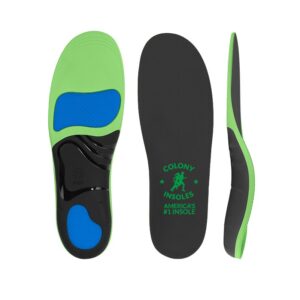 Doctor-Designed Orthotic
Premium Colony Ortho RX
- Recommended by podiatrists
- Memory foam + gel with real arch support
- 60-day money-back guarantee
- Free shipping within the USA
What a supinating foot fails to do
Healthy locomotion depends on a brief window of pronation right after heel contact. During that window the midtarsal joints unlock, the medial longitudinal arch lowers, and stored elastic energy bleeds off as the tissues stretch. A cavus, high-arched foot skips this step. The arch is too rigid to flatten, so the structure cannot convert vertical force into deformation. Impact that should have been absorbed at ground level instead propagates upward through the tibia toward the knee. Lateral column overload and chronically shortened calf muscles are simply the downstream cost of energy that had nowhere to go.
Where the orthotic intervenes
Colony Ortho RX is a podiatrist-engineered device, not a soft pad dropped under a stiff foot. Its contour fills the deep arch of a cavus foot and applies a lateral-to-medial cue, nudging center of pressure away from the outer border during midstance. A laminated memory foam deck over a gel platform then supplies the cushioning a rigid arch can never produce on its own. The aim is mechanical: keep the lateral edge from swallowing every footstrike.
Feet that tend to supinate
Distance runners who track laterally, trail hikers crossing cambered ground, and people carrying high, inflexible arches all share the same loading bias and the same telltale outsole wear along the outside edge.
- Cavus-profile arch fill matched to a tall, inflexible foot type
- Layered memory foam over gel delivering the impact absorption a supinator cannot generate
- Redirects center of pressure toward a more even medial-lateral split
- Steadies the rearfoot and quiets lateral-border strain
- Free USA shipping with a 60-day money-back guarantee
Once impact is dampened properly and the foot is guided closer to neutral, the stress traveling up the limb starts to settle and each step feels more governed underfoot. Unsure how your foot loads? Pair this with our breakdown of insoles for high arches, dial in athletic fit through our running shoe inserts guide, and if your shins protest, see insoles for shin splints.
A single orthotic, built to counter what underpronation disrupts, $29 the pair. Order Colony Ortho RX and test them risk-free.
Related Insoles & Guides
- Insoles for Underpronation
- Insoles to Correct Supination & Outward Roll
- Insoles to Correct Supination (Outer Foot)
- Shoe Inserts to Correct Supination
Frequently Asked Questions
How can the same insole that controls pronation also help a foot that underpronates?
Because the goal is the same in both directions: a centered rearfoot. In supination the calcaneus stays tilted into inversion and load runs down the lateral column. The contoured heel and arch geometry guides the rearfoot toward neutral alignment and brings the medial side of the foot into the load-sharing it has been avoiding, so force spreads instead of stacking on one border.
Won't extra arch support be the wrong thing for an already-high arch?
The cavus foot’s problem isn’t too much arch height — it’s too little contact. When the midfoot arches away from the ground, body weight concentrates at the heel and the fifth-metatarsal border. A contoured support that fills that gap gives the medial column somewhere to rest, spreading load across the whole plantar surface instead of leaving two small zones to absorb everything.
What happens to the impact my rigid arch can't absorb?
It travels. A supinated foot skips the brief pronation phase in which the midtarsal joints unlock and the arch lowers to dissipate energy, so vertical force passes through the heel and climbs the tibia toward the knee. The gel base performs part of that missing attenuation at ground level, intercepting shock the skeleton would otherwise carry upward.
Why do my ankles feel unstable and my calves stay tight if supination starts at the heel?
An inverted calcaneus keeps the foot rolled toward its outside edge, which leaves the lateral ankle ligaments working near their limit on every uneven surface — hence the giving-way feeling. The rigid-lever gait also robs the stride of its energy-bleed phase, so the calf muscles absorb and hold more tension than they should. Centering the rearfoot addresses both at the source.