Most men never inspect the foam slab tucked under their feet until something downstream starts complaining. A nagging arch by mid-afternoon, a heel that protests the first step out of bed, a low back that tightens after a day on the warehouse floor. The shoe gets blamed; the real culprit is the structureless liner inside it that contributes nothing to how force moves through your body.
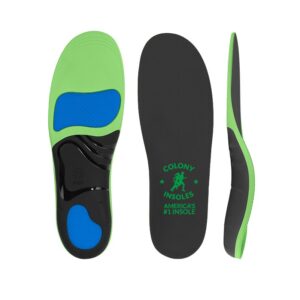 Doctor-Designed Orthotic
Premium Colony Ortho RX
- Recommended by podiatrists
- Memory foam + gel with real arch support
- 60-day money-back guarantee
- Free shipping within the USA
The biomechanics a stock liner ignores
Every stride sends ground reaction force back up through the heel at roughly your body weight, and more when you walk or lift. A thin die-cut foam insert has no shell, no rearfoot post, and no deep heel cup, so it cannot reposition that load or hold the calcaneus square. Within a few weeks it packs down to a flat sheet, after which the medial longitudinal arch drops, the foot rolls inward, and the unabsorbed shock keeps climbing the kinetic chain toward the knees, hips, and lumbar segments.
Orthotic structure built to carry working loads
The Colony Ortho RX insole is engineered as a biomechanical device rather than a cushion. Its semi-rigid arch shell resists collapse under repeated loading and keeps the rearfoot tracking in a neutral column, which limits excess pronation through the stance phase of gait. A dense gel platform sits beneath, dissipating impact energy on concrete, asphalt, and steel decking so less of it transmits proximally. A contoured deep heel cup centers the fat pad under the calcaneus, where most men feel the first ache. This is podiatrist-designed support meant to keep the foot mechanically efficient from the first hour to the last.
Built for men who stay on their feet
Tradesmen, machinists, line cooks, distance runners, and anyone parked at a standing desk benefit when the foot has a real platform underneath it. The insole seats cleanly in work boots, trainers, and casual shoes, and you trim along the printed outline for a snug match to your shoe size.
- Semi-rigid arch support shell that limits pronation across long shifts
- Dense gel platform engineered for shock attenuation on hard, unforgiving surfaces
- Deep heel cup that stabilizes the calcaneus and centers the plantar fat pad
- Podiatrist-designed for sustained, full-day biomechanical demand
- Trims along a printed guide for a precise fit in boots and trainers
Runners logging real mileage can carry the same rearfoot control into our insoles for running, while men whose job keeps them upright should review our work shoe inserts. If heel pain is your main concern, our notes on plantar fasciitis support explain the mechanics.
Stop feeding unmanaged load up your legs and spine through a flattened liner. Order your Colony Ortho RX orthotic insoles and put a real biomechanical platform under every step.
Related Insoles & Guides
- Walking Insoles for All-Day Comfort
- Women's Insoles for All-Day Comfort
- Insoles for Standing All Day
- Colony Ortho RX vs VKTRY: All-Day vs Sport
- High Arch Insoles for All-Day Comfort
- Comfort Insoles for All-Day Relief
Frequently Asked Questions
What does a semi-rigid arch shell do that the foam liner in my boots can't?
It opposes collapse. Every step loads the medial longitudinal arch with body weight trying to flatten it; the semi-rigid shell resists that deformation and holds the heel bone in a more neutral column, limiting excess pronation through the stance phase. A die-cut foam liner has no shell, no rearfoot post, and no deep heel cup, so it can do none of this.
Why do my lower back and knees tighten after a day on my feet?
Often the chain starts at the ground. Once a packed-down liner lets the medial arch drop, the foot rolls inward and each heel strike sends unabsorbed shock climbing toward the knees, hips, and lumbar segments. Controlling pronation at the rearfoot and dissipating impact at the heel addresses the mechanics; persistent back pain still deserves its own evaluation.
Does my heel really absorb close to my full body weight on each stride?
Roughly, yes. Walking returns ground reaction force through the heel at about body weight, and the figure climbs when you move faster or carry loads on the job. That is why the design pairs a dense gel platform that dissipates impact energy with a deep heel cup that keeps the calcaneus square as those forces repeat thousands of times a day.
Can one pair move between my work boots and my sneakers?
Yes, with one caveat. Trim using the factory liner from the roomier pair as your template, and the insole will transfer between shoes of similar size. Footwear with a removable liner gives the full-length shell and deep heel cup the depth they need to sit flat and control the rearfoot the way they are designed to.