What a low arch means for foot mechanics
A low or collapsed medial longitudinal arch is one of the most common structural patterns we see at Colony Ortho RX, and it changes how load moves through the foot with every step. When the arch sits low, the rearfoot tends to roll inward and the midfoot loses the rigid lever it needs to push off cleanly. Mass-produced shoes are built around a flat, average last, so a low arch gets very little structural backing. The small intrinsic muscles, the posterior tibial tendon, and the plantar fascia end up working overtime to compensate, and that compensation shows up as early fatigue.
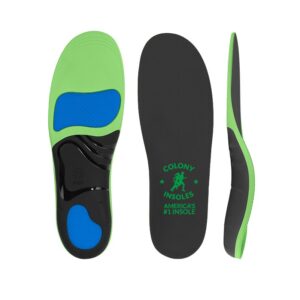 Doctor-Designed Orthotic
Premium Colony Ortho RX
- Recommended by podiatrists
- Memory foam + gel with real arch support
- 60-day money-back guarantee
- Free shipping within the USA
Why an unsupported arch drives strain
With the arch flattening under load, the foot pronates excessively and weight migrates toward the medial column. That overworks the supporting soft tissue, and the strain rarely stays local. Excessive pronation rotates the lower leg inward, which can carry stress up through the ankle, shin, and knee. Stretch that across a full day on your feet and the result is the deep ache that meets you when you finally sit down. The aim of orthotic support here is straightforward: control the rate and degree of pronation so the structures above the foot are loaded more evenly.
How our orthotic supports a low arch
This insole is built around a structured, geometric arch engineered to hold a low arch up firmly and resist the collapse that drives medial overload. By supporting the arch through midstance, it encourages the rearfoot toward a more neutral position as you move. The memory foam and gel layers handle shock attenuation across the rest of the footbed, so structural correction and impact cushioning work together rather than at each other’s expense. This is the kind of medical-grade, all-day support our podiatrist-designed approach is built on, made for feet that have gone without it for too long.
- Geometric arch engineered to support a low or fallen medial arch
- Helps control the excessive pronation that fatigues flat feet early
- Memory foam and gel for consistent shock attenuation underfoot
- Encourages a more neutral rearfoot position through the gait cycle
- One medical-grade orthotic that drops into the shoes you already wear
Who this is for
If you have flat feet, arches that ache, or feet that fatigue sooner than they should, structured arch support is the foundation the rest of your alignment depends on. Because excessive pronation transmits stress up the kinetic chain, many of our customers also read our guide on insoles for knee pain to understand how rearfoot control influences the whole leg.
Your arches have been compensating for a long time. Give them real structural backing. Try Colony Ortho RX risk-free for 60 days with free USA shipping, and if the support doesn’t measure up, we’ll refund the full amount. Get your Colony Ortho RX and give your arches the engineered structure they’ve been missing.
Related Insoles & Guides
- Insoles for Flat Feet & Arch Support
- High Arch Insoles for All-Day Comfort
- Running Insoles for Arch & Heel Relief
- Insoles for Skechers: Add Arch Support
- High Arch Support Insoles for Pain Relief
- Easy Feet Comfort Insoles
Frequently Asked Questions
What is actually happening inside a flat foot during each step?
With a low medial arch, the rearfoot tends to roll inward under load and the midfoot never re-forms the rigid lever needed for a clean push-off. Weight migrates toward the medial column, so the posterior tibial tendon, plantar fascia, and small intrinsic muscles work overtime to compensate — which is why flat-footed days so often end in that deep, disproportionate ache.
Does a collapsed arch explain soreness in my shins and knees?
It can contribute. Excessive pronation rotates the lower leg inward as the arch flattens, and that rotation can carry stress up through the ankle, shin, and knee with every stride — the strain rarely stays local to the foot. That is why support here targets the source: control pronation at the arch and the structures above are loaded more evenly.
Will wearing the insole permanently rebuild my arch?
No, and honest expectations matter. An orthotic changes how your foot is loaded while you wear it; it does not remold bone or ligament. The working goal is controlling the rate and degree of pronation — slowing the inward roll, supporting the arch through midstance, and giving push-off a stiffer lever — so overworked tissue gets backup each step you take in them.
How should firm arch support feel under a flat foot at first?
Expect to notice contact under the arch — a flat foot is rarely used to being met there, so firm support can feel prominent during the first wearings. Easing in over shorter sessions lets the soft tissue adapt. Steady, supportive pressure is the goal; sharp or persistent pain is not, and it warrants a podiatrist’s input, especially with known posterior tibial problems.