Why Hip Pain Often Begins at the Foot
Hip discomfort rarely announces a foot problem, yet the two are mechanically linked more often than most people expect. When the medial arch loses its structural integrity and the rearfoot drops into excessive pronation, the limb rotates inward from the ground up. That rotational chain travels through the tibia, alters knee tracking, tilts the pelvis, and asks the hip musculature to compensate for motion the foot should have controlled. The hip ends up absorbing a load that was never meant to reach it.
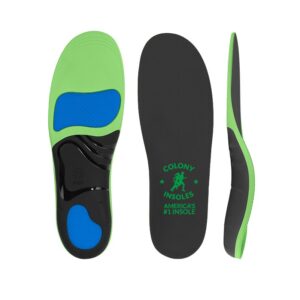 Doctor-Designed Orthotic
Premium Colony Ortho RX
- Recommended by podiatrists
- Memory foam + gel with real arch support
- 60-day money-back guarantee
- Free shipping within the USA
The Body as a Kinetic Chain
Standing posture behaves like a stacked, linked system. When the base segment tilts, every segment above it adjusts to keep the trunk upright. A foot that collapses medially drives internal rotation at the knee, anteriorly tilts the pelvis, and leaves the hip stabilizers working overtime through every stance phase. Layer on a hard, unattenuated heel strike and a small impulse transmits up that chain with each footfall. Restore rearfoot alignment and attenuate the impact early, and the hip is no longer recruited to brace against forces that started two joints below.
The Orthotic Mechanics Behind the Support
Colony Ortho RX is podiatrist-designed orthotic support, engineered to control motion rather than simply pad the foot. A structured arch profile resists medial collapse and guides the foot toward a neutral subtalar position, which limits the internal rotation that loads the hip. Beneath it, a layered foam-over-gel construction attenuates ground reaction forces near the point of contact, before they propagate proximally. People who stand through long clinical or industrial shifts often notice the steadiness of their gait before the soreness eases. This is medical-grade support doing quiet biomechanical work, stride after stride.
- Structured arch support that limits excess pronation and the internal rotation it drives upward
- Shock attenuation at the heel that reduces ground reaction force reaching the hip
- Foam-over-gel layering that dampens impact at each footstrike
- Rearfoot positioning that promotes a more symmetrical, controlled gait
- Medical-grade orthotic construction built for hours of weight-bearing
Who Tends to Benefit
If you are weight-bearing all day and your hips carry the cost by evening, this support was designed with your biomechanics in mind. One clinical caveat: orthotic insoles can reduce mechanical strain, but they do not replace a diagnosis. Persistent or worsening hip pain warrants evaluation by a qualified clinician, so please have it assessed. To see how the same support serves the rest of the kinetic chain, browse our insole store, or read about all-day wear on the sweaty feet page.
Your hips already absorb more than their share of the load. Give the kinetic chain a corrected foundation to work from. Start with a pair of Colony Ortho RX and address the problem where it begins.
Related Insoles & Guides
- Heel Inserts for Heel Pain Relief
- Heel Cups for Heel Pain Relief
- Shoe Inserts for Foot Pain Relief
- Insoles for Ball of Foot Pain Relief
- High Arch Support Insoles for Pain Relief
- Insoles for Knee Pain Relief
Frequently Asked Questions
How can an insole in my shoe change what my hip feels?
Through the kinetic chain. When the medial arch collapses and the rearfoot over-pronates, the tibia rotates inward, knee tracking shifts, the pelvis tilts, and the hip stabilizers fire overtime through every stance phase to compensate. Supporting the arch and realigning the rearfoot controls that rotation at its source, so the hip stops bracing against motion the foot should manage.
Does heel-strike impact really travel as high as the hip?
Each hard, unattenuated heel strike sends a small impulse up the stacked chain — tibia, knee, femur, pelvis. One footfall is trivial; thousands per day are not, especially when inward rotation has already left the hip musculature working off-axis. Attenuating that impact early, at the heel, is one of the two mechanical jobs this orthotic performs, alongside alignment.
What kind of hip discomfort is most likely foot-driven?
Suspect the feet when hip ache builds with time on your feet rather than with specific hip movements, pairs with flattened arches or medially worn outsoles, or favors the side that pronates harder. Hip pain with trauma, night pain, clicking, or restricted range deserves a clinician’s evaluation first — not every hip problem starts at the ground.
When could my hip respond after starting orthotic support?
Timelines vary, and honest answers beat promises. The mechanical change — less inward rotation, softer impact — begins with the first wear, but hip muscles that have compensated for months unload gradually, often over weeks of regular use. Wear the insoles daily, let your gait adapt, and use the 60-day return window as your evaluation period. Persistent pain warrants professional assessment.