Lace a skate as tight as it needs to be and your foot is sealed inside a shell that barely flexes. That rigidity is the point, since it channels stride force straight into the blade, but it also leaves the sole of your foot pressed against a flat, uncontoured base with nothing cradling the structures doing the work. Colony Ortho RX hockey insoles were engineered by a podiatrist to give that sealed-in foot the platform a skate boot leaves out, so your mechanics stay organized through every period.
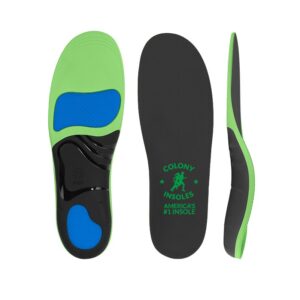 Doctor-Designed Orthotic
Premium Colony Ortho RX
- Recommended by podiatrists
- Memory foam + gel with real arch support
- 60-day money-back guarantee
- Free shipping within the USA
Why edge work wears the foot down
Crossovers, hard stops, tight transitions: each one loads the subtalar joint with rotation and shear while your foot stays clamped to a rigid thermoplastic shell. The liner that ships in most boots has essentially no contour, leaving an empty pocket under the medial arch. As a game wears on, the small stabilizing muscles tire, the arch starts sinking, and the foot begins rolling inward right when you need a stiff lever to cut a clean edge. Energy that belonged on the ice gets lost in a sagging midfoot.
Adding a sculpted arch support rewrites that pattern. By filling the gap under your arch and checking overpronation, the orthotic hands the foot a firm surface to press against, routing stride force to the steel instead of into a collapse. Tucked beneath that brace, a memory foam tier paired with gel takes on the impact damping a stiff boot ignores, dulling the jolt that fires up your leg each time you slam to a stop.
What players feel on the ice
- A sculpted arch that locks down the midfoot and reins in pronation inside a clamped boot
- Gel that dampens the jolt of abrupt braking and aggressive edge bite
- Memory foam that takes the shape of your sole over several skates
- Less arch and rearfoot fatigue late, so your closing shifts feel like your first
- A profile you can trim to move from skate boot to street shoe
Power left for the last shift
Once a foot loses its platform, your balance in a corner battle slips, your push-off softens, and bench recovery drags. Putting the structure back keeps your stride honest and your legs under you. A lot of skaters who train off-ice also ask about our running inserts for dryland days, and if you carry a tall instep, our guide to high-arch support deserves a read, since that foot type drives load down the outer column. Same orthotic core, equally ready for the rink.
No lab mold is required to stop a flat liner from undercutting your skating, and bracing your mechanics makes sense for any player, even though it is not a stand-in for having a specific injury looked at by a clinician. Each pair runs $29, ships free across the U.S., and carries a 60-day return promise. Set a pair into your skates and feel your base stay solid, shift to shift.
Frequently Asked Questions
Doesn't a rigid skate boot already give my foot enough support?
The shell is stiff, but the factory liner under your foot is essentially flat, leaving an open pocket beneath the medial arch. A sculpted orthotic fills that gap so the arch has a surface to bear against, instead of sinking inside an otherwise unforgiving thermoplastic boot.
How does arch support change what happens on crossovers and hard stops?
Each crossover and stop loads the subtalar joint with rotation and shear. When the arch sags, part of your stride force disappears into a collapsing midfoot. A firm arch checks that inward roll, so the force you generate travels through an organized foot into the blade rather than being absorbed by the collapse.
Can a trim-to-fit insole actually work inside a snug skate?
Yes. Pull the stock footbed out, use it as a template, and trim the orthotic to match before sliding it in. Because you are replacing the flat insert rather than stacking on top of it, the added volume is modest. Re-check lace tension and toe room after the swap.
Why does my edge work feel sloppier by the third period?
As the foot’s small stabilizing muscles fatigue, the arch starts to drop and the foot rolls inward, exactly when you need a stiff lever to cut a clean edge. An orthotic provides external support that does not tire, helping maintain rearfoot alignment late in games as muscular control fades.