A blister is a mechanical event, not bad luck
Skin does not break down at random. A friction blister is the predictable outcome of repeated shear loading: the epidermis is dragged back and forth against the deeper dermal layers until the tissue planes separate and fluid fills the void. The trigger is almost never the shoe material alone. It is relative motion, the foot sliding against the lining stride after stride, and that motion appears whenever nothing inside the footwear holds the foot in a fixed position during gait.
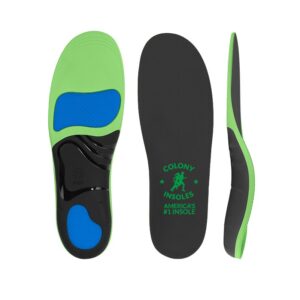 Doctor-Designed Orthotic
Premium Colony Ortho RX
- Recommended by podiatrists
- Memory foam + gel with real arch support
- 60-day money-back guarantee
- Free shipping within the USA
Tracing the shear back to its source
Consider where the rubbing concentrates. At the posterior heel, an unanchored calcaneus lifts and re-seats on every step, sawing the back of the foot across the counter. At the forefoot, a foot that migrates distally grinds the toes and metatarsal heads into the toe box. A flat, compressed factory liner permits both motions because it neither cradles the rearfoot nor occupies the shoe’s spare volume. Every millimeter the foot travels translates into surface shear, and that shear is the raw material every blister is built from. Reduce the displacement and most hot spots never reach threshold.
How the orthotic interrupts the friction cycle
Our strategy is to attack the slide rather than bandage the skin. A contoured arch shell and a deep heel seat lock the foot into one repeatable position, so the relative motion driving the shear is largely removed at the source. The molding top surface tracks with the foot instead of abrading it, and by filling unused interior space the platform denies the foot the room it needs to wander. One pair, $29, working quietly to take your skin out of the friction equation.
- Rearfoot and arch control that fixes foot position and cancels relative sliding
- A conforming top layer that moves with the skin rather than dragging across it
- A volume-filling fit that removes the slack a foot exploits to migrate
- Impact cushioning that eases the loading while you break in a stiff pair
- A clinically designed orthotic build, shipped free across the US
This is worth trying if
you are wearing in fresh footwear, covering long distances, or you reliably raise the same hot spots no matter the sock or shoe. A foot that is mechanically anchored changes the entire equation. Because slack footwear and blistering are two faces of the same motion problem, our guide on how to make shoes tighter reads naturally alongside this. If the culprit is specifically heel lift at the back, the anchoring methods in our sliding forward piece will help. This is educational and not a substitute for clinical care.
Wearing your own shoes should not require taping your feet first. Give them a stable, cushioned foundation and let the recurring hot spots disappear. Trial Colony Ortho RX risk-free under our 60-day money-back guarantee. Order today and log the miles without the friction.
Related Insoles & Guides
- Best Shoe Inserts for All-Day Comfort
- Heel Inserts for Heel Pain Relief
- Gel Insoles for Real Shock Absorption
- Height-Boosting Shoe Inserts
- Orthopedic Shoe Inserts
- Arch Support Shoe Inserts
Frequently Asked Questions
How can something under my foot prevent a blister on the back of my heel?
Because the blister begins with motion, not the shoe material. An unanchored calcaneus lifts and re-seats every stride, sawing the skin across the heel counter. The contoured heel seat and arch shell hold the rearfoot in one position through gait, so the sliding that generates shear between skin layers largely never occurs.
What explains blisters in shoes that are definitely the right size?
Correct length does not mean a fixed foot. Nearly all footwear contains spare interior volume, and a flat, compressed factory liner neither cradles the rearfoot nor occupies that space. The foot still migrates a few millimeters each stride, and that repeated displacement is precisely the shear loading that separates skin layers and fills the gap with fluid.
Will a new contoured insole rub before my feet adjust to it?
Any new contour changes where your foot makes contact, so build up wear time gradually over the first several days. The mechanics work in your favor: the surface is designed to keep the foot seated rather than sliding, and a foot held in a fixed position produces far less of the friction that creates hot spots.
Can these replace taping and double socks on long walks?
They work at different layers. Tape and sock systems manage friction at the skin surface; the orthotic reduces the displacement that creates the friction in the first place. For everyday wear, anchoring the foot is often sufficient. For long hikes or known trouble spots, keeping both strategies in play is the sensible approach.