When the Length Is Right but the Hold Is Wrong
Perhaps the only pair on clearance ran a half-size large, or your feet narrowed a little over the years and now every step carries the faintest slide forward. This is one of the most common fit complaints we hear, and it’s more than a small irritation. Viewed through a biomechanical lens, a shoe with surplus internal volume lets the foot travel independently of the shoe, and that uncontrolled movement quietly works against you from the first step of the morning to the last of the night.
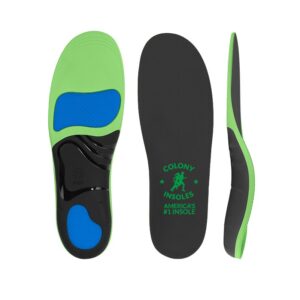 Doctor-Designed Orthotic
Premium Colony Ortho RX
- Recommended by podiatrists
- Memory foam + gel with real arch support
- 60-day money-back guarantee
- Free shipping within the USA
How Slack Volume Sabotages Your Mechanics
Extra room invites the foot to translate forward and back through each stride. That repeated shear is what rubs blisters onto the heel and toe-tips, and it forces the intrinsic foot muscles to clench and stabilize when they ought to be free to function across gait. Hours of that low-level gripping pile up into real fatigue by evening. A loose heel sabotages the gait cycle too, because the rearfoot can never settle into the same seated position at heel strike, robbing each step of a consistent foundation.
How Our Orthotic Rebuilds a Secure Fit
This orthotic occupies the excess volume and anchors the foot in a defined place. The layered memory foam and gel build adds true loft to the footbed, so a roomy shoe seats the foot as though it were sized correctly from the start. The structured arch support cradles the midfoot and halts forward translation, while the cushioning takes up the vertical gap that keeps the rearfoot locked down. One medical-grade orthotic, $29 a pair, and that imprecise fit is solved.
- Occupies surplus internal volume so oversized shoes hold the foot firmly
- Seats the rearfoot to shut down the shear that breeds blisters
- Memory foam that molds to the foot for a stable, repeatable fit
- A gel layer that attenuates impact so long days load the foot less
- Podiatrist-designed support that suits nearly any closed shoe
Who This Suits
If you’ve ever stuffed a wad of tissue into the toe box just to wear a shoe out the door, this is built for you, the bargain hunter, the person caught between sizes, anyone whose footwear has loosened after a few hundred miles. You shouldn’t have to give up good shoes over a fit that’s slightly off and the instability it breeds. This is the same correction people reach for to reduce the size of an oversized shoe, and it works hand in hand with our cushioned memory foam inserts for all-day plantar comfort. If you want the reasoning, see how orthotics work.
Give your oversized shoes a stable second life. Try our orthotic with free U.S. shipping and a 60-day money-back guarantee. Order your pair today and feel the change at the very first step.
Related Insoles & Guides
- Insoles to Make Shoes Smaller & Fit
- Insoles to Make Loose Shoes Fit Tighter
- Shoe Inserts for Shoes Too Big
- Shoe Inserts for Big Shoes
- Insoles to Make Shoes Smaller
- Insoles for Big Toe Joint Pain
Frequently Asked Questions
Can an insole stop my foot from sliding forward in a half-size-large shoe?
That forward travel happens because surplus internal volume gives the foot room to translate with every stride. By adding genuine loft through layered memory foam and gel, and filling the midfoot with a structured arch, the orthotic seats the foot against the shoe’s upper, so each step starts and ends with the foot in the same anchored position.
Why am I getting blisters from a shoe that is only slightly too big?
Blisters at the heel and toe tips are a shear injury. In a roomy shoe the foot slides forward and back through each stride, and that repeated friction against the same skin zones builds heat and breaks tissue down. Eliminating the slack movement, rather than padding the blister site, removes the shear that causes them.
What is my foot doing wrong in a loose shoe even before anything hurts?
Two quiet compensations. Your intrinsic foot muscles clench to stabilize the foot instead of working freely through the gait cycle, and that low-grade gripping accumulates into real fatigue by evening. Meanwhile the unanchored rearfoot lands in a slightly different position at every heel strike, denying each step the consistent foundation sound mechanics are built on.
How does this differ from wearing thicker socks or stick-on heel pads?
Those fixes add bulk at one spot without controlling the foot. A thick sock compresses unevenly through the day, and a heel pad addresses only the heel counter; neither creates midfoot contact or a defined seat. The orthotic occupies the excess volume across the full footbed and anchors the rearfoot, correcting the movement rather than cushioning its symptoms.