A Superfeet Alternative Built on Structure, Not Price Tags
If you’ve shopped premium orthotic inserts, you’ve met the big names and their big numbers. Colony Ortho RX exists because clinical-grade support shouldn’t require a premium price to put correction where the foot actually needs it. We designed a serious, hardworking orthotic without the sticker shock, focused on the biomechanics rather than the brand.
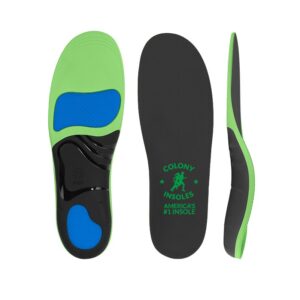 Doctor-Designed Orthotic
Premium Colony Ortho RX
- Recommended by podiatrists
- Memory foam + gel with real arch support
- 60-day money-back guarantee
- Free shipping within the USA
Why Arch Mechanics Decide How Your Day Feels
Your feet manage load from the first step out of bed to the last one back into it. When the medial arch isn’t supported, the foot pronates further through stance, and that strain doesn’t stay local. It transmits up the kinetic chain into the knees, hips, and lower back, quietly draining you by evening. Support here is structural, not cosmetic. The trouble with many rigid, one-note inserts is that they feel like a hard plank for eight hours. We wanted an orthotic that holds alignment and cushions soft tissue at the same time, not a trade-off between the two.
How Our Orthotic Solves It
Our single premium orthotic pairs memory foam with a responsive gel layer over a structured, geometric arch frame. The foam conforms to your foot contour and distributes plantar pressure, the gel attenuates shock at each heel strike, and the arch frame holds its form to control pronation mile after mile. That combination of support and cushioning in one slim, medical-grade package is why podiatrists point patients toward Colony Ortho RX.
- Memory foam that conforms to your exact plantar contour
- Shock-attenuating gel that buffers impact on hard surfaces
- Structured arch support engineered to hold its corrective shape
- One clinically focused design, $29 a pair, no confusing upsells
- FREE shipping anywhere in the USA
Who Reaches for This
On your feet all day, training hard, or simply done overpaying the shelf brands? This orthotic fits. Want to see how we compare elsewhere? Read our honest take on New Balance inserts, or look at everyday non-slip support for slick floors.
Try Colony Ortho RX risk-free for 60 days with our money-back guarantee. If they don’t help you stand, walk, and run more comfortably, send them back for a refund. This is educational, not personal medical advice, and ongoing foot pain deserves a clinician’s look. Order your pair and feel structured support from the first step.
Related Insoles & Guides
- Superfeet Insole Alternative
- Powerstep Alternative: One Premium Pair
- New Balance Insole Alternative
- Custom Made Shoe Inserts Alternative
- Colony Ortho RX vs Superfeet: Comfort & Value
- Powerstep Alternative
Frequently Asked Questions
What separates this from the rigid orthotic shells premium brands are known for?
Rigid, one-note inserts hold alignment but can feel like a hard plank across an eight-hour day. Ours layers conforming memory foam and a shock-attenuating gel pad over a structured arch frame, so the frame handles alignment while the soft layers manage plantar pressure and heel-strike impact. Structure and cushioning aren’t traded off.
Does the memory foam layer soften the actual arch support?
No — the layers do different jobs. The geometric arch frame underneath is what resists medial arch collapse and excess pronation through stance; it doesn’t rely on the foam for stiffness. The foam above conforms to your contour and spreads plantar pressure, which makes firm structural support wearable all day, not weaker.
How can a $29 orthotic compete with inserts costing two or three times more?
Because the functions that matter are mechanical, not branded: a frame that supports the medial arch, cushioning that distributes pressure, and shock attenuation under the heel. None of that requires a premium sticker to engineer. We put the cost into those biomechanics, skipped the markup, and backed it with a 60-day guarantee.
When is an off-the-shelf orthotic like this not the right tool?
When a clinician has identified something that needs a prescription device — a structural deformity, a significant measured leg-length difference, diabetic ulceration risk, or post-surgical offloading. For the far more common pattern of an unsupported arch overpronating and sending strain up the kinetic chain, a structured over-the-counter orthotic addresses the mechanics directly.