Tough Leather Says Nothing About the Footbed
Run a palm across a Red Wing upper and you feel craft: dense hide, stitched welts, a boot engineered to outlast punishment. None of that craft reaches the surface your sole actually rests on. The factory liner tucked into most work boots is a thin, level sheet that abandons the medial arch and lets the heel hammer a rigid outsole shift after shift. Set that on a concrete bay floor for ten hours and the gap announces itself in a hurry.
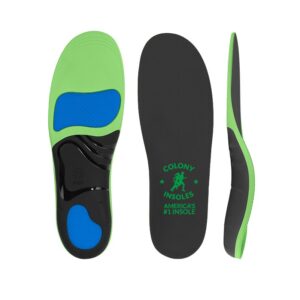 Doctor-Designed Orthotic
Premium Colony Ortho RX
- Recommended by podiatrists
- Memory foam + gel with real arch support
- 60-day money-back guarantee
- Free shipping within the USA
How a Flat Liner Climbs the Kinetic Chain
Lacking any structured arch support underneath, the foot tends to splay while the medial arch caves across stance. That surplus inward roll seldom keeps to itself. The rotational and alignment shifts it sets off can climb the chain, coloring how the ankle, the knee, and the lumbar spine handle load over a grueling week. A costlier boot won’t touch the issue; rebuilding arch geometry and governing how the foot loads is what will.
What the Footbed Does Inside Heavy Boots
This product is made to seat within rugged footwear and remake its mechanics from the liner upward. A memory foam with gel build molds to the shape of each foot, and the structured, geometric arch support resists deformation under heavy load instead of buckling flat. Down at the heel, the gel layer soaks up the shock a stiff work boot would otherwise drive straight into the calcaneus, keeping standing and walking better managed clear through the shift.
- A firm geometric arch built to defend its shape across long, heavy workdays
- Heel-zone gel damping that guards the calcaneus and the joints stacked above
- A foam surface that conforms yet refuses to pack down by midday
- Recommended by podiatrists and leaned on by people upright all shift
- Trims in seconds to settle into the deep cavity of most work boots
Who Belongs in These
If your work, your trail days, or your long outdoor hours open with lacing heavy boots, this footbed earns its place inside them. Electricians, framers, dock crews, and everyone who has limped toward the truck after clock-out notice the gain in support fast. Plenty add a second set for their off-clock shoes once the arch control lands, so do read our high arch insoles, our custom-feel shoe inserts, and our guide to heel pain relief.
The lines above offer general education on footwear mechanics and amount to no diagnosis. Priced at $29, each pair ships with delivery covered nationwide beneath our 60-day return promise. Pick up your Colony Ortho RX and mail them back should the support fail to suit your feet.
Related Insoles & Guides
- Insoles for Ski Boots: Warmer & Stable
- Insoles for Cowboy Boots
- Hiking Insoles for Boots
- Insoles for Work Boots
- Best Insoles for Nike Shoes
- Orthopedic Insoles
Frequently Asked Questions
Why do my feet still ache after a shift when the boots themselves are excellent?
Boot quality lives in the upper and outsole; the surface your foot actually loads is the liner, and most factory liners are thin, level sheets with no arch geometry. On concrete, the unsupported medial arch lowers through stance, the foot splays, and the heel hammers a rigid outsole all shift. The leather above can’t change any of that — the footbed can.
Will the arch support hold its shape under heavy loads like tools and materials?
It is built for that loading profile. The structured, geometric arch shell resists deformation under sustained weight instead of buckling flat the way soft foam does, so the medial column stays braced whether you are standing, climbing, or hauling. The memory foam and gel above handle conforming fit and impact; the shell underneath does the structural work hour after hour.
What is the right way to fit these inside a work boot?
Pull the factory liner out and use it as a cutting template: the Colony Ortho RX insole is trim-to-fit, so you match its outline with scissors and seat it flat against the boot’s footbed. Work boots generally offer generous interior volume, so the full-length insole and its heel gel layer sit correctly without crowding the toe box.
Can a flat boot liner really affect my knees and lower back?
It can contribute, because alignment changes rarely stay in the foot. When the medial arch caves across stance, the surplus inward roll alters rotation up the kinetic chain — ankle, knee, lumbar spine — changing how each segment handles load over a grueling week. Restoring arch geometry addresses that pattern at its source; established pain higher up still warrants a clinician’s evaluation.