Why Comparing Insole Brands Misses the Real Question
Stand in front of a pharmacy insole shelf and you will count thirty boxes, split across sport, comfort, and gel lines. The trouble is that none of those labels tells you what actually matters: whether the device controls how your foot loads the ground. I’m Jack Young, and I started Colony Ortho RX because choosing biomechanical support shouldn’t depend on guessing which marketing tier happens to fit your arch. The question isn’t which brand has the most models. It’s which design manages plantar fascia load, rearfoot position, and forefoot pressure across a full day on your feet.
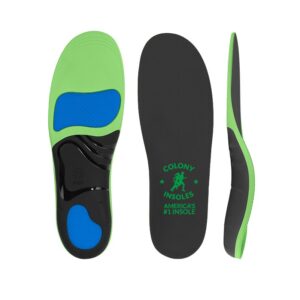 Doctor-Designed Orthotic
Premium Colony Ortho RX
- Recommended by podiatrists
- Memory foam + gel with real arch support
- 60-day money-back guarantee
- Free shipping within the USA
What a Sprawling Catalog Usually Hides
Large brands spread their engineering thin across a dozen near-identical models, which pushes the diagnostic work onto you. You’re left self-assessing arch height and gait, then gambling on the version that matches. Guess wrong and the device offers cushioning without correction, so soft foam compresses under load and your pronation goes unchecked by mid-afternoon. The models that pair cushioning with genuine structure tend to sit at the top of the price ladder. More options rarely means better support; it usually means more ways to choose a device that doesn’t address your mechanics.
One Orthotic Insole, Built for Correction
We deliberately went the other way. Rather than a catalog, we engineer a single medical-grade orthotic insole around what most feet need: a memory foam and gel layer for shock attenuation, seated on a structured, geometric arch shell that supports the medial longitudinal arch and helps guide rearfoot alignment. It’s the kind of construction podiatrists design around, at a flat $29 a pair, with no upsell to the model that finally corrects properly.
- One podiatrist-designed orthotic instead of a shelf of comfort look-alikes
- Structured arch support engineered to resist arch collapse under load
- Memory foam and gel for shock attenuation at heel strike
- Rearfoot positioning intended to help manage excess pronation
- Built to hold its corrective shape through long standing and walking
Want to know whether it suits your specific foot structure first? If your arches sit high and supinate, read our guide to high arch support. If your priority is cushioning mechanics, our memory foam insole page explains how the layers attenuate impact underfoot.
Who This Suits
This is for the person who is done comparing twelve models and wants one device built on sound biomechanics. The shopper who would rather not decode an insole wall, and who wants structural support they can rely on without a return trip. Educational guidance, not a diagnosis, but a sensible place to start.
Skip the maze and the inflated top tier. Every pair ships with free U.S. shipping and a 60-day money-back guarantee. Order your pair today and see why one well-engineered orthotic beats a wall of comfort boxes.
Related Insoles & Guides
- Shoe Inserts vs CVS Brands
- Colony Ortho RX vs Samurai Insoles Compared
- Colony Ortho RX vs Tread Labs Compared
- Colony Ortho RX vs Aetrex Compared
- Colony Ortho RX vs Sof Sole Compared
- Colony Ortho RX vs Spenco Compared
Frequently Asked Questions
What should I actually compare when every brand claims the best support?
Skip the marketing tiers and ask one question of any device: does it control how your foot loads the ground? Look for a defined arch contour, rearfoot stability, and materials that hold structure under repeated load. A sport-versus-comfort label tells you the box’s shelf category, not whether the insert manages plantar fascia load or pronation.
Do I need to figure out my arch height and gait type before ordering?
That self-diagnosis is exactly the burden multi-model catalogs push onto you — and guessing wrong buys cushioning without correction. Colony Ortho RX takes the opposite route: one orthotic engineered around the mechanics loaded feet broadly share, with arch support, rearfoot control, and shock attenuation built into every pair rather than split across guess-dependent versions.
What goes wrong when someone picks the mismatched model from a big brand's lineup?
The common failure is the soft, structure-free version: foam that compresses under load while pronation runs unchecked by mid-afternoon. You feel cushioned at breakfast and ache by closing time, because nothing in the device manages rearfoot position or arch load. The genuinely structured models in those lineups, meanwhile, usually sit at the top of the price ladder.
How does a $29 single-model orthotic compare with the premium tier of the big catalogs?
Structurally, it carries the elements those premium tiers charge extra for: a contoured arch shell, rearfoot positioning, and cushioning that pairs with correction instead of replacing it. Selling one design rather than fifteen keeps the engineering concentrated and the price flat, and a 60-day money-back guarantee covers the trial period a shelf purchase never offers.