Picture the demands of a single long rally: a split-step landing, a hard shuffle to run down a wide ball, a sliding stop in the corner, then an explosive recovery back to center. Tennis loads the foot sideways, rotationally, and on the brakes, often inside one point, in a way a forward-only runner never experiences. Colony Ortho RX tennis insoles were built by a podiatrist as an orthotic platform to manage that multidirectional load and keep your foot aligned deep into a third set.
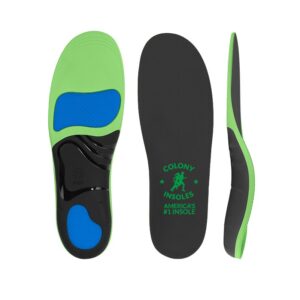 Doctor-Designed Orthotic
Premium Colony Ortho RX
- Recommended by podiatrists
- Memory foam + gel with real arch support
- 60-day money-back guarantee
- Free shipping within the USA
The toll a hard court takes
Concrete-based courts are quick and energetically flat, handing almost nothing back to your legs. Play becomes an endless cycle of loading, driving sideways, and decelerating. Every redirection forces the subtalar joint to restrain inward roll while the plantar fascia loads and unloads under tension and the heel bone absorbs strike after strike. A cushy, shapeless stock footbed offers zero rearfoot governance, so the foot caves, drifts around underfoot, and arch and heel both surrender early.
Our orthotic goes straight at that failure point. A rigid, sculpted arch support reinforces the medial column and resists overpronation on every cut, handing you a dependable lever to drive off. Stacked above it, memory foam and gel supply the impact damping the surface withholds, shaving the force peak at heel and forefoot. You end up with a foot that stays governed and squared from the first serve through the last.
Made for the grind of long matches
- A sculpted arch that resists inward roll and steadies the rearfoot through slides and lunges
- Gel that soaks up the shock a punishing hard surface refuses to absorb
- Memory foam that takes your foot’s shape for a secure, repeatable platform
- Lighter strain on the plantar fascia and heel across a full draw or back-to-backs
- A profile you can trim to seat firmly in low-volume court shoes
Keep your footing into the deciding set
As long as the foot holds its brace, gait stays efficient, which lets you push off with conviction, track down extra balls, and reset quicker across the rounds of a weekend event. Many players log conditioning miles too and ask us about running inserts; for a closer look at the cushioning tier by itself, the gel insoles page digs in. The same orthotic spine carries through both.
Shoring up how your foot loads is a sound call for anyone taking on the pounding of a hard court, though it is no substitute for getting a specific injury assessed. Each pair runs $29, ships free across the U.S., and is backed for 60 days, money returned if it misses. Set a pair into your court shoes and rally from a base that holds.
Frequently Asked Questions
What does tennis demand from a foot that straight-line running doesn't?
Tennis loads the foot sideways, rotationally, and under hard braking, often within a single rally. Every redirection asks the subtalar joint to restrain inward roll while the plantar fascia cycles under tension. A forward-only runner rarely sees these stresses, which is why rearfoot control matters more on court than in a running shoe.
How do these insoles make up for an unforgiving hard court?
Concrete-based courts hand almost no energy back, so your heel absorbs the full cost of every landing and sliding stop. The insole stacks memory foam over a gel layer to damp that repeated impact, while the rigid arch beneath keeps the cushioning from turning into instability when you drive laterally.
Will a rigid arch make my direction changes feel less stable?
The opposite is the goal. On a shapeless footbed the foot caves and drifts during cuts, wasting force. A sculpted arch reinforces the medial column and resists overpronation, giving you a firmer lever to push off when recovering to center. Expect a short adjustment period as your feet adapt to the contour.
Can an insole help arch and heel soreness after long matches?
It can address the mechanical side. Repeated landings load the plantar fascia under tension while the heel takes strike after strike, and a supported arch with a cushioned rearfoot reduces how much of that load concentrates in one spot. Persistent or worsening pain still deserves evaluation by a clinician, not gear changes alone.