Watch a child for an hour and you will see why their feet take a beating: they sprint, leap off the couch, land flat-footed on blacktop, and do it again before you can finish a sentence. When that same child starts mentioning sore heels after soccer or tired legs at bedtime, the flimsy liner in their sneakers is no longer keeping up with the forces a growing foot is generating.
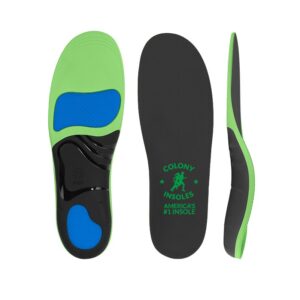 Doctor-Designed Orthotic
Premium Colony Ortho RX
- Recommended by podiatrists
- Memory foam + gel with real arch support
- 60-day money-back guarantee
- Free shipping within the USA
How developing feet manage load
A young foot is still forming. The bones are partly cartilaginous, the medial arch is often low or not yet fully shaped, and the growth plates are active through every spurt. Under running and jumping, a low arch tends to flatten further and the foot pronates, which lets repeated footstrike on hard gym floors and pavement travel up through the legs with little to absorb it. The paper-thin foam in most children’s shoes adds no shell and no shock control, so the foot shoulders the entire impact itself.
A stable base that keeps pace with play
Colony Ortho RX gives active kids a structured platform to push off from. A soft memory foam top molds gently to each developing foot, while a gel layer underneath attenuates the repeated impact of running, cutting, and landing. The contoured arch shell supports a forming medial arch and encourages the rearfoot to track more steadily through the gait cycle, helping the foot stay aligned during exactly the activity that would otherwise overload it. It is podiatrist-designed support parents can rely on for everyday wear.
Who it suits
Sporty kids, weekend young athletes, and any child arriving home with achy, fatigued feet after a full day in motion. The insole fits sneakers, cleats, and school shoes, and trims down for a snug fit that adapts as their feet grow.
- Memory foam top scaled to the demands of busy, growing feet
- Gel shock attenuation for running, jumping, and landing on hard ground
- Contoured arch shell that supports a forming arch and steadier rearfoot tracking
- Podiatrist-designed support parents can trust
- Trims for a custom fit in sneakers and cleats
For kids in organized sport, the same structured build runs through our insoles for running, and you can compare the whole lineup of athletic shoe inserts for the family. If your child reports persistent heel pain, our overview of heel pain in active children is worth reading.
Give growing feet a supported base to play on. A pair is $29 with free USA shipping and a 60-day money-back guarantee, so trying them carries no risk. Order Colony Ortho RX and keep your child moving with confidence.
Related Insoles & Guides
- Insoles for Diabetic Feet
- Insoles for Flat Feet & Arch Support
- Insoles for Low Arches & Flat Feet
- Easy Feet Comfort Insoles
- Insoles for Wide Feet: Full-Width Support
- Insoles That Mold to Your Feet
Frequently Asked Questions
Why would a child need more support than the liner that came in their sneakers?
Because a growing foot absorbs enormous repetition with very little help. The bones are still partly cartilaginous, growth plates stay active through every spurt, and the paper-thin foam in most kids’ shoes adds no shell and no shock control. A gel layer to attenuate repeated footstrike and a contoured shell to steady the rearfoot give those forces somewhere to go.
Is a low arch in a growing child something an insole should fix?
A low arch is common while the foot is still forming, and an insole does not reshape it. What the arch shell does is support the forming arch under running and jumping loads, so it flattens less and the foot pronates less during play. An arch that looks markedly asymmetric or hurts persistently deserves evaluation by a pediatric clinician.
What might explain sore heels after soccer practice and tired legs at bedtime?
Mechanically, it is repetition on unforgiving surfaces: hundreds of landings on blacktop and gym floors with a liner that absorbs almost nothing, so the heel and lower legs take the impact directly. Cushioning under the heel and steadier rearfoot tracking reduce that load. Heel pain that persists or worsens warrants an exam, since growth plates are active at that age.
When should the insoles be re-trimmed or replaced as my child grows?
Re-fit them every time shoe size changes. The trim-to-fit design lets you use the factory liner from each new pair of sneakers as a cutting template, so the support keeps pace with growth instead of lagging a size behind. After trimming, check that the heel sits centered in the cup and the toes clear the front edge.